

ADHD and Sensory Overload: When Everything Feels Too Much
ADHD and Sensory Overload: When Everything Feels Too Much
Everyone else at the table kept talking like nothing was happening. Plates clinking, three conversations overlapping, someone's chair scraping the floor every few minutes. You were counting the seconds until you could get outside. Same room, same noise level, completely different experience.
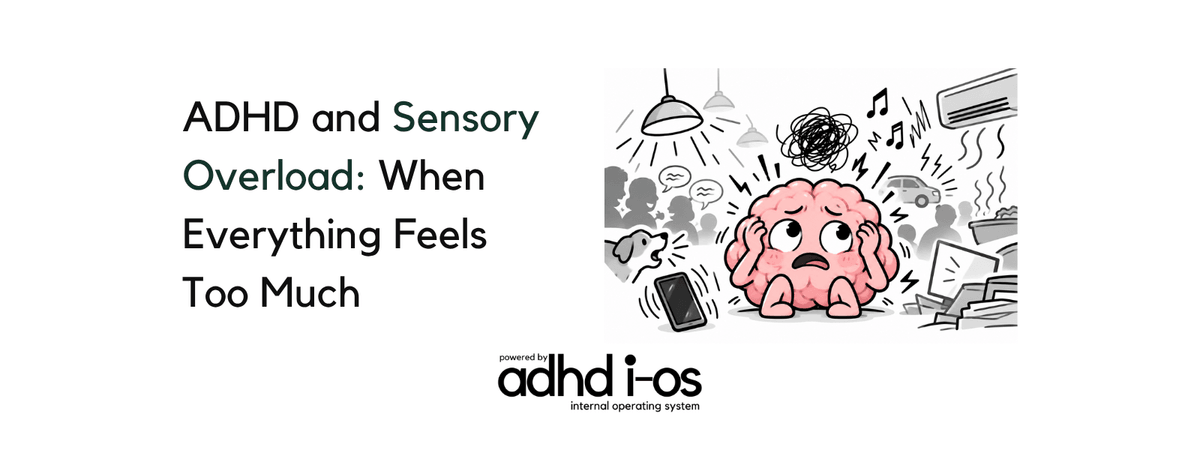
The Room Wasn't That Loud. You Still Had to Leave.
Sensory overload in ADHD isn't oversensitivity for its own sake. A 2025 systematic review and meta-analysis pooled 30 studies and more than 5,000 participants and found people with ADHD scored significantly higher than controls across sensory sensitivity, sensory avoidance, sensory seeking, and low sensory registration, a pattern that held across both children and adults. That's not a handful of small studies with a shaky signal, it's one of the more thoroughly documented differences in how ADHD brains actually work.
Spot It Early: Four Signs and What to Do About Them
Catching the signal early beats pushing through it every time. A few ways to do that:
- Notice the early signals: a short temper, snapping answers, sudden irritability at small noises that wouldn't normally register.
- Build a five-minute exit plan before you enter a loud or bright space, so leaving doesn't require a decision in the moment.
- Keep one sensory off switch on you, earplugs, sunglasses, a hoodie, rather than hoping you won't need it.
- Step outside before the overload peaks, not after.
So why does a normal room feel like too much in the first place? It comes down to how the ADHD brain filters what comes in.
The Brain Isn't Broken. The Filter Is Different.
Most brains automatically mute background stimulation so the important things stand out: the conversation you're in matters, the hum of the air conditioner doesn't, and most people never consciously sort one from the other. It happens before they're even aware a decision got made.
A 2018 study surveyed 234 people across the general population and found a highly significant correlation between ADHD traits and self-reported sensory processing problems, across every sensory domain tested, not just sound or just light. The more ADHD traits someone had, the more sensory difficulty they tended to report, which suggests the two are part of the same underlying pattern rather than two unrelated issues that happen to overlap. Less of the input gets quietly turned down before it reaches conscious awareness, so more of it arrives at full volume, all competing for attention at the exact same time, with nothing nudging one conversation above the clatter of plates behind it.
Why It Hits the Body Before the Mind Notices
Sensory overload often shows up physically before it registers as a thought. A jaw clenching. Hands tightening. A wave of exhaustion after a ten-minute errand that should have been nothing.
A 2010 study out of Virginia Commonwealth University measured cortisol and skin conductance in children with ADHD during a structured sensory challenge, and found that a subgroup of children, those who also showed sensory over-responsivity, had measurably different physiological stress responses than children with ADHD who didn't. That's an important nuance: it's not every single ADHD brain reacting identically, it's a distinct, measurable subgroup with real hormonal and nervous system signatures, not just a kid who seems more sensitive on a questionnaire.
When Overload Turns Into a Meltdown
Left unaddressed, sensory overload can build past the point of coping into a full shutdown or meltdown: sudden tears, sharp irritability, or a need to physically remove yourself immediately, with no real warning that it was coming, or at least none you noticed in time.
A meltdown usually isn't a loss of control so much as a nervous system that ran out of runway, the warning signs missed or ignored for too long before there was any room left to act on them. By the time it's visible from the outside, it's already been building for a while on the inside. It's closely related to ADHD and emotional flooding, where the same mismatch between how fast a signal arrives and how slowly the brain can regulate it plays out emotionally instead of sensorially, often at the same time.
Not the Same as Sensory Soothing
This piece is about the overload itself: why it happens, and how to catch it early. Managing an already-overwhelmed nervous system is a related but separate skill. ADHD and Sensory Soothing: How You Calm Your Overloaded Brain covers that half, the fidgeting, the pacing, the headphones, all the ways the nervous system tries to self-regulate once it's already past its limit. This article is about the limit itself, and what happens in the moments leading up to it.
Reframing Sensory Overload
Sensory overload isn't a sign you're too sensitive or overreacting. It's a measurable difference in how much stimulation gets through the filter before it reaches your conscious mind.
Instead of asking "why can't I just handle this like everyone else," try asking "what early signal did my body give me, and did I have room to act on it." That second question actually points somewhere useful, the same way noticing restless energy as information, rather than a flaw, opens up what to actually do about it.
Everything Feels Too Much? That's Not an Overreaction.
That restaurant table from the start wasn't actually loud. Your nervous system just let in more of it, at full volume, with less getting quietly filtered out before it reached you. Not an overreaction, just a measurably different filter running on the exact same room everyone else was sitting in without a problem.
Physical warning signs tend to show up before the overwhelm even registers consciously, tight shoulders, a clipped tone, restlessness that has nowhere obvious to go. Left unaddressed, that buildup can turn into a meltdown or shutdown.
Catching the early signals matters more than pushing through longer ever will.
Explore more neuroscience-backed ADHD tools at adhd i-os and learn how to catch overload before it catches you.