

ADHD and Emotional Flooding: Why Feelings Hit So Hard
ADHD and Emotional Flooding: Why Feelings Hit So Hard
Do you get that feeling too?
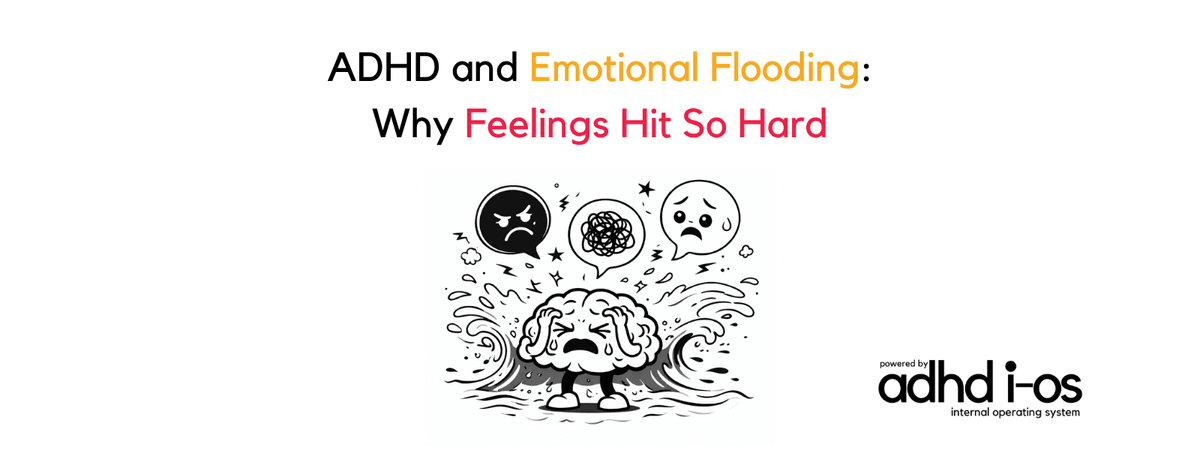
When you receive a small piece of feedback, and within seconds, your chest tightens. Your thoughts start racing. Emotions surge before you have time to process what was actually said.
What just happened is often described as ADHD emotional flooding.
For many people with ADHD, emotions do not build gradually. They spike. Fast, intense, and often overwhelming. What might seem like a minor trigger can quickly feel all-consuming.
This is not about being overly sensitive. It is not a lack of discipline or maturity.
It is a nervous system response.
Research increasingly shows that ADHD affects not just attention, but also how the brain processes and regulates emotion. Emotional flooding is one of the clearest expressions of this difference.
Understanding what is happening neurologically changes the conversation. Instead of asking “What is wrong with me?” the better question becomes:
What is my brain doing right now?
Emotional Dysregulation in ADHD: The Core Issue
ADHD is often framed as a disorder of attention. That framing is incomplete.
A growing body of research identifies emotional dysregulation as a central feature of ADHD. This includes:
- Rapid emotional escalation
- Difficulty calming down once activated
- Strong reactions to relatively small triggers
- Increased sensitivity to perceived rejection or criticism
Studies show that emotional regulation challenges are common in ADHD and significantly impact daily functioning. Similarly, CHADD emphasizes that emotional regulation difficulties are a core part of ADHD, not a side effect.
This matters because it reframes the experience.
What looks like an overreaction is often a regulation gap.
The system that generates emotion is highly responsive. The system that regulates it is slower to engage. And that mismatch is where emotional flooding begins.
What Emotional Flooding Actually Is
Emotional flooding occurs when the intensity of an emotional response exceeds the brain’s ability to regulate it in real time.
In simple terms:
The emotion arrives faster than your brain can process or manage it.
Common characteristics include:
- Sudden spikes in emotional intensity
- Loss of perspective in the moment
- Difficulty taking in new information
- Strong physical sensations (tight chest, heat, restlessness)
- A longer recovery period after the trigger
During emotional flooding, the brain prioritizes emotional processing over logical reasoning. That is why it becomes difficult to think clearly, communicate effectively, or respond proportionately.
For ADHDers, this happens more frequently because of how emotional and regulatory systems interact.
Brain Science: Why ADHD Emotions Escalate Quickly
The Limbic System Reacts First
The limbic system, particularly the amygdala, is responsible for detecting emotional significance.
It answers one question quickly: Is this important or threatening?
As a matter of fact, ADHD is associated with heightened emotional reactivity in these regions.
This means emotional signals can feel stronger and more urgent.
The Prefrontal Cortex Regulates Response
The prefrontal cortex is responsible for:
- Impulse control
- Emotional regulation
- Perspective shifting
- Decision-making
In ADHD, differences in prefrontal cortex functioning are well documented, thereby, affecting the brain’s ability to regulate emotional responses in real time.
When Reaction Outpaces Regulation
Emotional flooding happens when:
- The limbic system activates quickly
- The prefrontal cortex lags behind
- The nervous system remains activated longer than needed
This creates a temporary imbalance where emotion dominates, and regulation struggles to catch up.
It's not that regulation does not exist, per se. It's just that it arrives later than normally expected.
How Emotional Flooding Shows Up in Daily Life
Despite what many might think, this pattern is not all made up and it shows up in very real ways:
- Feedback feels overwhelming, even when constructive
- Conversations escalate faster than intended
- Tears or anger appear suddenly
- Regret or embarrassment follows afterward
- It takes longer to return to baseline
Over time, this can impact relationships, work performance, decision-making, and worse, self-trust.
It often feeds into a familiar loop: Intense reaction → shame → self-criticism → increased sensitivity next time
This is where many ADHDers begin to internalize the experience as a personal failure rather than a neurological pattern. That interpretation is inaccurate and unhelpful.
The Nervous System and Emotional Recovery
One of the most overlooked parts of emotional flooding is recovery time.
For ADHDers:
- Emotional spikes can last longer
- The nervous system stays activated longer
- Returning to baseline takes more effort
Research on emotional regulation in ADHD supports this extended activation pattern
This is why “just calm down” is ineffective advice. The system is not ready yet.
Recovery, in this case, is simply about giving the nervous system time and support to settle.
Tools That Help Interrupt Emotional Flooding
Effective strategies do not start with thinking. They start with regulation.
1. Pause the Environment - Remove yourself from the trigger when possible. Space reduces continued activation.
2. Regulate the Body First - Use simple physiological inputs:
- Slow breathing
- Movement
- Grounding through touch or sensory input
The body must settle before the mind can engage.
3. Label the Emotion - Interestingly enough, simply by naming the emotions that you feel helps activate regulatory networks in the brain. Even something simple like “I am feeling overwhelmed” or “I am feeling angry” works.
4. Delay Responses - Avoid responding immediately during emotional flooding. Give the prefrontal cortex time to come back online.
5. Reduce Shame Narratives - This is critical because the response is neurological. Removing self-judgment reduces secondary emotional load. And they work because they align with how the brain actually functions, we call them regulatory supports, in this case.
6. The Last Resort - If none of these work, then it might be time to consider getting effective therapy that is designed for ADHD. Afterall, consulting with a professional is always the best course of action when all else fails.
When the System Is Understood, It Becomes Manageable
Emotional flooding in ADHD is the result of how emotional and regulatory systems interact in the brain. Case in point, when reaction consistently outpaces regulation, emotions feel bigger, faster, and harder to manage.
Understanding this shifts the focus from control to support. From blame to strategy.
Now, because the nervous system is supported, regulation improves. Then, when regulation improves, emotional experiences become more manageable.
Nothing is broken. You just need to work WITH system just needs, not AGAINST it.
So, instead of trying to stop the reaction, start by supporting what happens after it begins.
If this resonated, notice one moment this week where your emotional response escalates faster than expected. Pause just long enough to ask: Is this a personal failure, or is this my nervous system activating faster than I can regulate?
adhd i-os exists to help build systems that support emotional regulation, not fight it. For a deeper understanding of how the ADHD brain processes emotion and how to work with it effectively, explore more inside the adhd i-os resources.