

The ADHD Boredom Spiral: How It Sabotages Productivity
The ADHD Boredom Spiral: How It Sabotages Productivity
It starts as most things do: A task is opened. A tab is clicked. A plan is in place.
But within minutes, your attention starts to drift.
Not because the task is too difficult or because the outcome is unclear. But because you find it boring.
For many ADHD entrepreneurs, this is where productivity quietly collapses.
This pattern is often misunderstood as a distraction or a lack of discipline. In reality, it is something far more specific and far more predictable: the ADHD boredom spiral.
At its core, this spiral is driven by differences in how the ADHD brain processes stimulation, reward, and motivation cycles. When a task fails to generate enough engagement, the brain does not simply “push through.” It disengages.
Understanding the connection between ADHD boredom and productivity is not optional for high-performing founders. In fact, it is foundational to how you should function.
Why ADHD Brains Experience Boredom Differently
Dopamine and Reward Processing
The ADHD brain is not deficient in capability, as most would like to think it is. Merely, it is inconsistent in activation.
ADHD involves differences in dopamine transmission, particularly in how the brain anticipates and responds to rewards.
This has a direct impact on motivation: Tasks with immediate feedback, novelty, or urgency tend to activate attention quickly. Tasks with delayed payoff, repetition, or low stimulation often fail to engage the brain at all.
Starting a task that appears simple on the surface can feel neurologically “flat,” making it significantly harder to initiate or sustain. T
Understimulation vs Overwhelm
Most conversations about ADHD focus on overwhelm. But the fact is, understimulation is just as disruptive.
ADHD productivity struggles are not always caused by too much input. In many cases, they are caused by not enough. Research on arousal regulation suggests that ADHD brains require a higher level of stimulation to maintain optimal performance.
When that threshold is not met, attention drops rapidly.
Reframing a critical misconception: The issue is not distraction but insufficient engagement.
The ADHD Boredom Spiral Explained
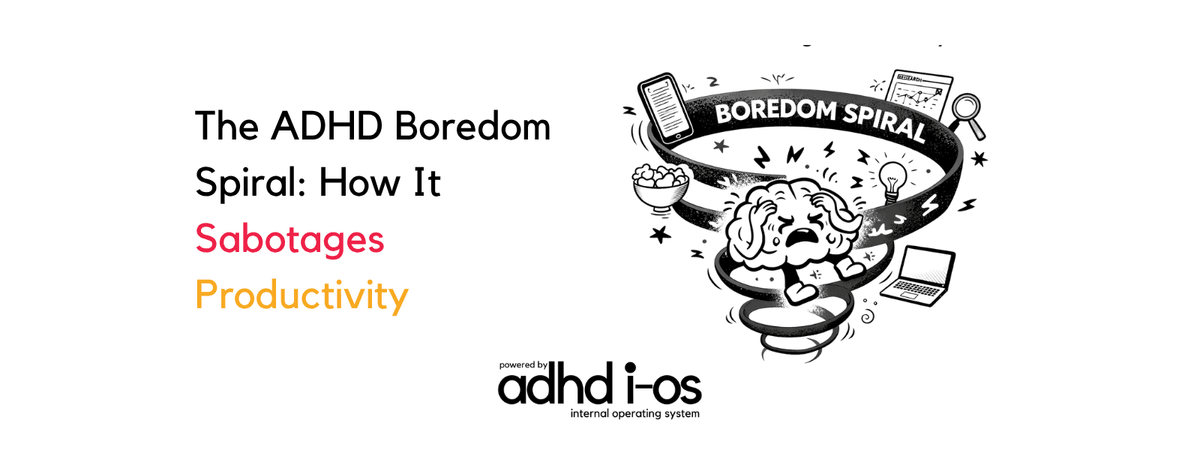
The boredom spiral does not happen all at once. It unfolds in predictable stages.
Stage 1: Low Stimulation
The task feels slow, repetitive, or mentally flat.
Stage 2: Dopamine Drop
Motivation decreases almost immediately. The brain begins searching for something more engaging.
Stage 3: Micro-Avoidance
Small behaviors appear: checking messages, switching tabs, and grabbing a snack. Each action offers a short dopamine boost.
Stage 4: Shame Response
Internal dialogue shifts to “Why is this so hard?” or “This should be easy.”
Stage 5: Productivity Collapse
The task remains unfinished, and pressure increases. Then, deadlines become the only reliable motivator.
This is where ADHD task paralysis and ADHD motivation problems begin to compound (in a bad way).
The longer the spiral continues, the more energy is required to restart.
Why Boredom Feels Physically Uncomfortable
Boredom, in the ADHD brain, is not neutral. It is often experienced as discomfort.
Restlessness builds, irritability increases. Even mental agitation rises.
This is tied to low cortical arousal, where the brain is actively seeking stimulation to reach an optimal state.
The result is not passive disengagement but an internal pressure to escape the task.
This distinction matters. Because it reinforces a critical truth:
You are not lazy nor dysfunctional. You simply need to regulate.
How the Boredom Spiral Sabotages Productivity
Left unaddressed, the boredom spiral creates very specific patterns in business performance.
- Multiple projects started, a few completed
- Administrative work is consistently delayed
- Deadlines are used as a primary motivator
- Energy cycles that swing between hyperfocus and avoidance
For high-capacity ADHD entrepreneurs, this becomes especially frustrating.
From there, you might find that the ability to perform is not the issue. The ability to engage consistently is.
And that gap is often misinterpreted as inconsistency or lack of follow-through.
When in reality, it is a mismatch between task design and brain function.
Research-Backed Strategies to Interrupt the Spiral
The goal is to engineer around boredom.
1. Increase Immediate Reward Signals
The ADHD brain responds to visible progress and immediate feedback.
Effective approaches include:
- Time boxing tasks into short intervals
- Tracking progress visually
- Creating artificial deadlines
These techniques shorten the reward loop and improve engagement.
2. Add Stimulation Intentionally
Stimulation can be designed into the work environment.
Examples include:
- Body doubling or working alongside others
- Incorporating movement into work sessions
- Changing physical environments to reset attention
This aligns with how Grow Disrupt designs event environments to support focus and retention through intentional stimulation and structure.
3. Reduce Shame Loops
The emotional layer of the boredom spiral often does more damage than the task itself.
Interrupting this requires:
- Externalizing the task instead of internalizing failure
- Separating ability from the current dopamine state
- Adjusting how the task is structured rather than forcing completion
This proper emotional regulation moves the focus from willpower to design.
Productivity Is Not a Willpower Problem
The ADHD boredom spiral is just a mismatch between how the brain is wired and how most work is designed.
When tasks rely on delayed rewards, low stimulation, or rigid structure, the ADHD brain does exactly what it is built to do. It disengages, not out of avoidance, but out of regulation.
This is where the conversation needs to change. Productivity comes from understanding the patterns at play and designing systems that work with them, and surely, not just pushing harder..
When stimulation, structure, and reward are intentionally built into the process, follow-through stops feeling like a constant uphill battle.
That is when consistency starts to show up and when momentum becomes sustainable.
That is when productivity becomes reliable.
So, go breakthrough and create the conditions where focus can happen naturally.
If this resonated, start by noticing one moment this week where boredom shows up faster than expected. Pause just long enough to ask: Is this a lack of discipline, or is this a stimulation mismatch?
adhd i-os exists to help build systems and environments that support the ADHD brain instead of pushing against it. For a deeper dive into the neuroscience and practical strategies behind focus, motivation, and follow-through, explore more inside the adhd i-os resources.