

ADHD and Restless Energy: The Neurological Drive to Move
ADHD and Restless Energy: The Neurological Drive to Move
For many people with ADHD, stillness is not neutral. It is uncomfortable, distracting, and sometimes almost impossible.
There is often a constant internal motor running in the background. A pull toward movement. A need to shift, tap, pace, or adjust. This is commonly labeled as hyperactivity, but that label misses what is actually happening.
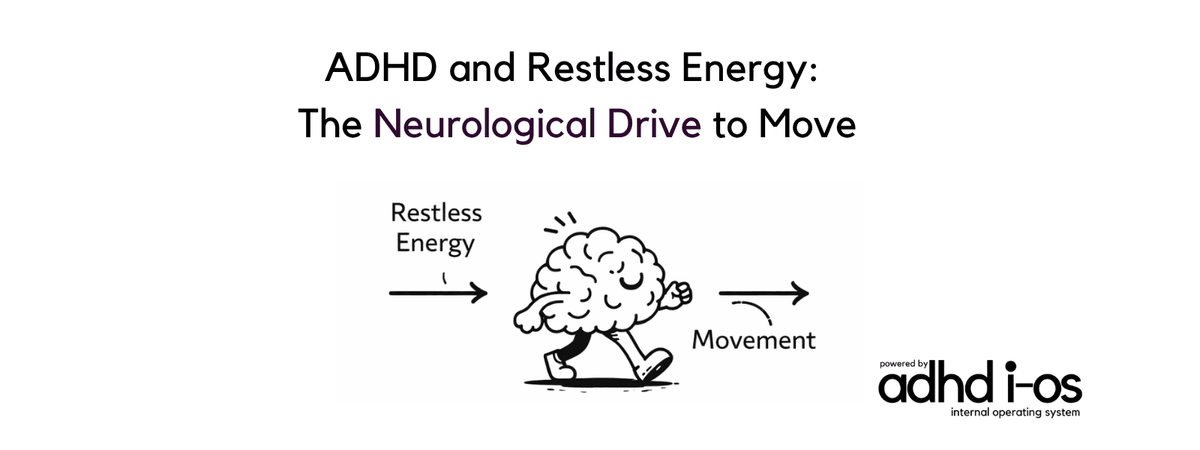
What looks like restlessness is often regulation.
ADHD restless energy is frequently misunderstood as a behavioral issue or lack of discipline. In reality, research shows ADHD is rooted in differences in brain function, particularly around attention, arousal, and executive control.
Movement is not random. In fact, it serves a purpose. For many ADHD brains, movement helps maintain alertness, increase stimulation, and support focus.
Without it, attention can drop quickly. With it, thinking often becomes clearer.
The need to move is not a flaw. On the contrary, it is often the brain’s attempt to stay engaged in an environment that does not naturally support how it operates.
What Restless Energy in ADHD Actually Is
Hyperactivity vs Internal Restlessness
Hyperactivity is often associated with visible movement, especially in children. Running, climbing, constant motion. But that is only one version.
In adults, ADHD hyperactivity frequently becomes internal.
It shows up as:
- A constant sense of agitation
- Mental restlessness or racing thoughts
- The urge to move, even when staying still, is expected
This is important to remember,r as many adults with ADHD do not appear “hyperactive” externally, but internally, the system is far from calm.
There are three overlapping forms at play:
- Motor hyperactivity – physical movement
- Internal restlessness – a felt sense of needing to move
- Cognitive restlessness – difficulty sustaining mental stillness
Understanding this shift explains why ADHD hyperactivity in adults often goes unrecognized.
The “Motor Regulation” Role of Movement
Movement is not just output. It also includes the input.
Interestingly, motor activity can help regulate arousal levels in the ADHD brain, improving attention and executive functioning.
In simple terms, movement helps the brain wake up.
Without enough stimulation, attention systems struggle to engage. Movement increases sensory input, which can help stabilize focus.
This is why:
- Fidgeting can improve concentration
- Walking can make thinking clearer
- Small movements can support sustained attention
What looks like a distraction is often the brain trying to find the level of stimulation it needs to function.
The Brain Science Behind ADHD Movement
Dopamine and the ADHD Brain
Dopamine plays a central role in motivation, reward, and attention.
In ADHD, dopamine regulation works differently. Levels may be lower or less efficiently used, which affects how the brain responds to tasks, especially those that are not immediately stimulating.
Movement can help.
Physical activity increases dopamine availability. Even small movements can provide just enough stimulation to improve focus and engagement.
This is why sitting still boredom often makes attention and productivity worse, not better.
The ADHD brain is not avoiding focus. More often than not, it is just under-stimulated.
Brain Regions Involved in Hyperactivity
Several brain regions are involved in ADHD movement patterns:
- Prefrontal cortex – responsible for planning, attention, and impulse control
- Basal ganglia – involved in movement regulation and habit formation
- Motor networks – coordinate physical activity
When these systems are underactivated, the brain may compensate by moving.
Movement can act as a way to “activate” attention systems that are not naturally engaging.
This reframes hyperactivity entirely. Instead of excess energy, it is now a response to under-activation.
Why Sitting Still Can Make ADHD Symptoms Worse
Traditional environments reward stillness.
Classrooms. Offices. Meetings. Long periods of sitting and sustained focus without movement.
For the ADHD brain, this creates a mismatch.
When movement is restricted:
- Arousal levels drop
- Attention becomes harder to maintain
- Cognitive fatigue increases
Research shows that movement can improve attention and working memory in individuals with ADHD.
Yet most environments are designed to suppress it.
The result is predictable: Focus declines because the environment removes a key regulatory tool.
Signs Restless Energy Is Neurological Regulation
Restless energy is often misread. But there are clear patterns that suggest it is functional, not disruptive.
Common signs include:
- Focus improves while walking or pacing
- Thinking becomes clearer with small movements
- Fidgeting increases concentration, not distraction
- Stillness leads to mental fog or shutdown
These patterns align with ADHD symptom profiles described by organizations like CHADD.
The key signal is this: If movement improves focus, it is not the problem. It is part of the solution.
Reframing Restlessness: Movement as a Cognitive Tool
Movement is often treated as something to control or eliminate.
That approach fails because it misunderstands the function.
For many ADHD brains, movement is a source of stimulation and a method of regulation. When used intentionally, it becomes a cognitive tool.
Practical examples include:
- Walking while thinking through problems
- Using fidget objects during focused work
- Standing desks or dynamic workspaces
- Structured movement breaks between tasks
The goal is not to force stillness. It is to create conditions that allow the brain to function effectively.
When Movement Is Allowed, Focus Improves
Movement is not a distraction from focus. For many ADHD brains, it is part of the pathway to focus.
When the body is allowed to regulate through motion, the mind often becomes more stable, more attentive, and more capable of sustained effort.
Instead of forcing stillness, the more effective approach is to design environments that allow the brain to function the way it is wired. When systems align with neurological needs, consistency becomes easier, and productivity becomes more natural.
What changes is not the person. It is the conditions. At adhd i-os, this is the shift that matters.
adhd i-os exists to build systems that work with how the ADHD brain actually operates, not against it. Systems that reduce friction instead of demanding constant control. Systems that recognize that what looks like a distraction is often regulation in disguise.
If this resonates, explore more neuroscience-backed insights and practical strategies designed for how your brain works in our blogs.