

ADHD and Working Memory Overload: The Real Reason You Shut Down
ADHD and Working Memory Overload: The Real Reason You Shut Down
You're mid-task. Mid-sentence. Mid-anything.
And then it happens. Your brain blanks. The words disappear. The steps evaporate. Your body might freeze, or you might snap, or you might suddenly need to leave the room.
From the outside, it can look like you stopped trying. But what most people don't see is that it can feel like someone pulled the plug.
Here’s the reframe adhd i-os is built on: shutdown is often a working memory overload problem, not a motivation problem. Our whole mission is helping ADHDers feel seen and supported with neuroscience-backed strategies that fit how your brain actually runs.
This article explains what working memory actually does, why ADHD brains hit capacity faster, what overload feels like, and how to reduce the load so access to your skills comes back.
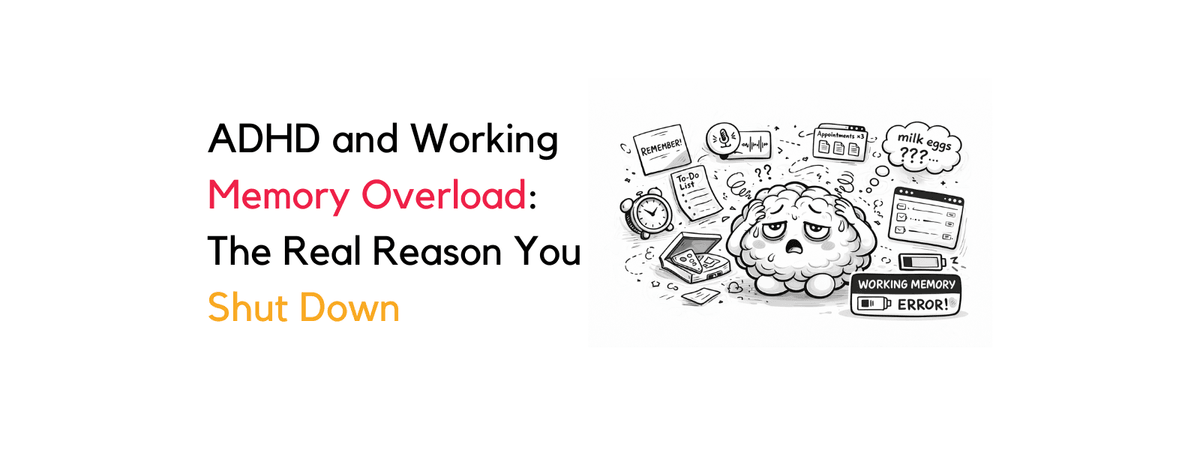
What "working memory" Actually Does
Working memory is your brain's short-term "holding space". It lets you keep a few bits of information online long enough to use them.
Most people confuse it with intelligence or effort when, in actuality, it is a limited mental workspace.
Working memory helps you do things like:
● hold a thought while you search for the right word
● remember the next step while doing the current one
● keep track of what someone just said while you prepare your response
● juggle multiple instructions without losing the thread
Researchers often describe it as temporary storage plus active manipulation, coordinated by an "executive" control system.
It might be helpful to imagine working memory like a small tray. You can carry a few items at once. Add too many, and everything starts sliding off.
Why ADHD Brains Hit the Limit Faster
Many people with ADHD experience differences in executive functions, including the ability to hold and manage information in working memory, especially under distraction or pressure.
This is why overload can happen during tasks that look "simple" on paper.
Because "simple" tasks often are not simple in the brain. They are stacks of hidden steps where one thing leads to another and, suddenly, you are overwhelmed.
Here's what overload stacking can look like:
● you get a multi-step instruction, then one more instruction, then a reminder
● your phone buzzes, your email pops, someone talks to you from another room
● you try to hold the steps, manage the social response, and regulate the stress at the same time
Even if you understand the task perfectly, working memory can still cap out. And once it caps out, access to what you know gets blocked.
Simply put, once working memory caps out, you are more likely to lose executive function. It is not a reflection of your character; simply, your brain has had enough.
Also worth noting: not every person with ADHD has the same working memory profile, and research suggests working memory deficits are not universal across all adults with ADHD.
Despite this variability, one thing still stands- the lived experience of "blanking" can still be explained by overload dynamics, especially when stress, distraction, and task-switching pile on.
What Overload Feels Like From the Inside
Working memory overload has a very specific feel. Common internal experiences include:
● suddenly going blank
● freezing or shutting down
● irritability, panic, or tears
● "I know this, but I can't access it"
● losing words mid-sentence
● rereading the same line and absorbing nothing
Outside perception vs inside reality can be painfully mismatched.
Outside, someone might see: "They are ignoring me." Inside, you might be thinking: "I'm trying so hard and nothing is loading."
Then the aftershock hits: shame, frustration, self-blame, and the old question: “What is wrong with me?”
Know that you are not alone and that experiencing overload does not mean you outright refuse to do something; it just means that you do not have the capacity to do so in the moment.
Why Shutdown is the Brain's Safety Response
When your brain is asked to hold more than it can hold, it will try to protect you.
Shutdown is often the circuit breaker. It stops more input. It narrows the system. It buys time for recovery.
You can think of it like a computer with too many tabs open. At some point, it does not run slower; it stops responding.
Stress makes this more likely. When stress rises, your brain has fewer resources available for working memory and executive control. That means the exact moment you "need to pull it together" is often the moment your brain has the least capacity to do it.
What Actually Helps: Less Load Equals More Function
The core principle is simple: move information out of your head and into the world. Think of it like a clutch. Something to make information access easier.
Here are practical, realistic supports that reduce load fast:
1. Externalise immediately
Write the next step down the moment it appears. Phone app, sticky note, or voice memo. Do not trust "I'll remember" when you are already close to capacity.
2. Shrink the task to one clear next step
Instead of "do the report", go to:
● "Open the document."
● "Find the last section I wrote."
● "Write three rough bullet points."
A single next step is often enough to restart movement.
3. Use visual checklists
Working memory struggles with holding sequences. A visible list removes that burden.
● Daily reset list
● "Leaving the house" list
● "Start work" list
● "End work" list
4. One task at a time (for real)
If you are switching between tasks, you are asking working memory to re-load context repeatedly. If possible, try:
● one screen
● one task
● one timer
● one "parking lot" note for intrusive thoughts you want to return to later
5. Reduce inputs before you try to push outputs
If you are already blanking, adding more instructions usually makes it worse.
Instead, aim for fewer words, choices, decisions, and more space. Experimentation beats perfection here.
How Friends, Partners, and Family Can Support
If you love someone with ADHD, your tone matters as much as your words. Pressure increases the load. Support reduces it.
What helps:
- Simplify instructions: one request at a time
- Help externalize: “Want me to write the first 3 steps down with you?”
- Drop urgency language: urgency spikes stress, which shrinks working memory
- Name what you see with compassion: “Looks like overload. Want a reset or a tiny next step?”
- Believe the experience: safety reduces shame, and shame is rocket fuel for shutdown
That “safe to be human” feeling is more common than you realize and even easier to feel with the right support.
Try This Today
Pick one working memory support to experiment with this week:
● Write down your next three steps before you start a task
● Create a visible "brain dump" space where thoughts can live outside your head
● Set up one simple checklist for a routine you do daily
● Use voice memos to capture instructions or ideas the moment you receive them
ADHD brains operate best with scaffolding. It might seem like a weakness, but it really is just simple biology. Honor that and find a system that works for you.
If you wish to read more content like this, join the adhd i-os community for weekly insights, experiments, and tools that don't fight your brain; they fit it.
When Capacity Is Respected, Function Returns
The key is in reducing the load. When working memory is no longer flooded, the system stabilizes. Language comes back. Steps become visible again. What looked like avoidance was often a brain protecting itself from overload.
If you want a starting point, notice where your capacity actually drops during the day. Is it after too many inputs? Too many tabs? Too many unspoken steps? Choose one place to externalize instead of internalize. One list. One next step. One reduction in noise.
When the load decreases, access returns. Access to what you already know. Access to skills you already have. Access to momentum that never disappeared, it just got buried.
adhd i-os exists to help you build systems that respect capacity instead of testing it. If this resonated, explore more neuroscience-backed insights inside the adhd i-os community and join us on Instagram for more of those “that explains everything” moments.