

ADHD and Object Permanence: Out of Sight, Out of Mind (Explained)
ADHD and Object Permanence: Out of Sight, Out of Mind (Explained)
If it leaves your line of sight, it can leave your brain. Not in a dramatic way. In a “wait, that existed?” way.
You put the bill somewhere “safe.”
You open a text and think, I’ll reply in a second.
You finally organize a space… and somehow make your life harder.
Then it resurfaces. The deadline. The follow-up message. The forgotten item. And right behind it comes the reflex: guilt, shame, and that quiet question, “Why is my brain like this?” Then, you shut down due to overload.
On adhd i-os, this pattern is common. Don't beat yourself up over it, it is not a moral failure nor is the end of the world.
It's simply an attention system issue. Which means: it can be supported.
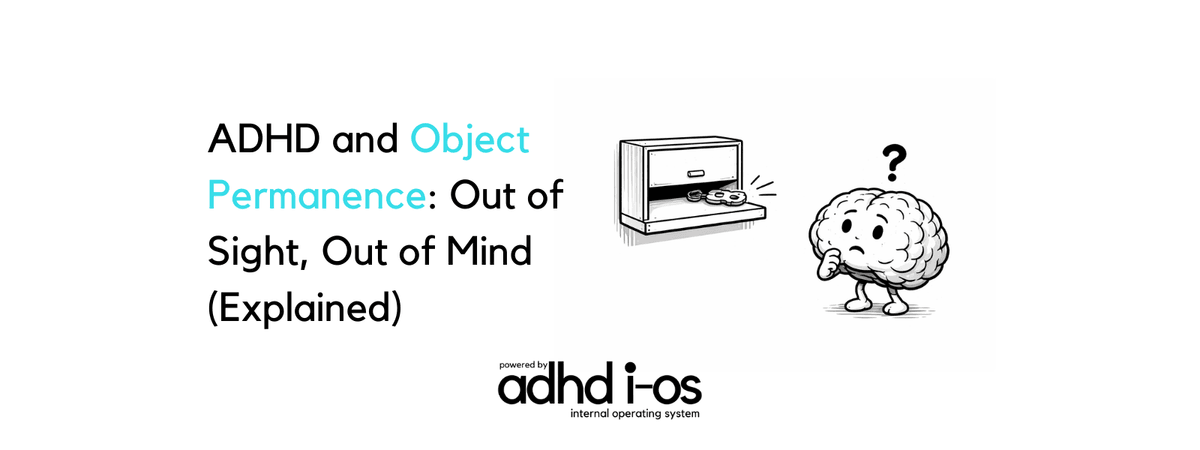
What ADHD Object Permanence Actually Means
“Object permanence” is a developmental psychology term, but in ADHD spaces, it is often used as shorthand for out of sight, out of mind.
In ADHD, the bigger issue is usually attention regulation and working memory, not caring and not intelligence. ADHD makes it harder to keep information “online” without a cue, which is part of the broader executive-function picture.
So when the cue disappears, the mental tab often closes.
Common examples:
- Bills not visible → bills not mentally active
- Texts not answered immediately → time collapses
- Items put away → items feel “gone
- Tasks not in your face → tasks lose urgency and emotional presence
Why It Gets Misread (And Why That Hurts)
From the outside, this can look like:
- “You’re irresponsible.”
- “You don’t care.”
- “If it mattered, you would remember.”
But ADHD challenges often show up as inconsistent performance in organization, follow-through, and daily responsibilities, even when motivation is real.
This is the key reframe: You did not forget because it wasn’t important. You forgot because your brain stopped pinging it.
You are a human whose brain happens to function differently; these are definitely not a reflection of your character.
What It Feels Like From the Inside
Many ADHDers recognize this experience instantly:
● “I forgot because I couldn’t see it anymore.”
● “I was genuinely surprised when it came back up.”
● “I feel awful because I really do care.”
Emotionally, ADHD object permanence often comes with:
● A spike of panic when something resurfaces
● Guilt for forgetting
● Shame about “always being like this.”
● Over-apologizing for things that were never intentional
This is why “just remember” advice fails. It ignores how cue-driven ADHD attention can be and ignores effective emotional regulation.
Why Visibility Matters So Much for ADHD Attention
Your environment is not just your environment. It is part of your brain’s support system.
External cues reduce demand on the prefrontal executive system, which is already working harder in ADHD.
Translation: “Hidden systems require internal tracking. Internal tracking is the hardest part.”
So the goal is not “try harder.” The goal is “make it visible.”
Tools That Actually Help ADHD Object Permanence
There is no shame in admitting that sometimes, we need assistance. Here are some ways to do that:
Tool One: Anchor It Visually
If it matters, it needs a visual anchor.
● Sticky notes
● Whiteboards
● Wall calendars
● Labels on doors, drawers, or bins
Research on attention shows that visible cues (retro cues) keep tasks in working memory longer. For ADHD object permanence, this means your brain is far more likely to keep something “online” if it keeps seeing it.
Tool Two: Use External Reminders (Not Willpower)
Alarms, recurring calendar alerts, task apps, and auto-reminders turn “later” into something your brain can actually notice.
If it helps, think of reminders as prosthetic executive function rather than a personal weakness.
Tool Three: Keep Storage Open or Clear
For ADHD brains, “tidy” can accidentally become “invisible.”
Clear bins, open shelves, and intentionally visible “active items” reduce the mental load of remembering what exists.
Tool Four: Give Important Things One Home
Keys, meds, wallet, charger: one consistent, visible home base.
Fewer locations = fewer opportunities for disappearance.
Tool Five: Build a “return cue”
This is the missing piece for texts, emails, and unfinished tasks:
- leave the tab open intentionally
- pin the message
- schedule a follow-up reminder the moment you read it
The cue is the bridge back.
How Other People Can Support ADHD Object Permanence
If someone wants to help an ADHDer with object permanence, pressure is the wrong tool. Support works better than shame.
Helpful shifts:
- “Quick ping” reminders instead of moral language
- shared visual systems (a board, a calendar, a checklist)
- fewer “you should” statements
- more “what cue would help here?”
When the environment does more remembering, the person carries less shame.
Strengthening ADHD Object Permanence
Object permanence challenges in ADHD are not about caring less or trying harder. They are about how attention and working memory rely on cues to keep priorities active. When important things become visible and structured, the brain no longer has to carry the entire burden of remembering on its own.
Small, repeatable supports such as visual anchors, reminders, and consistent homes for important items reduce the strain on executive function. Over time, these systems make it easier for priorities to stay present and for follow through to happen with less friction.
Looking for more support for your i-os? Read more neuroscience grounded tools in NeuroSpicy Weekly, and join the adhd i-os community to learn and practice alongside others who understand how these systems actually work.