

Why Transitions Feel Impossible for ADHD Brains (And What Helps)
Why Transitions Feel Impossible for ADHD Brains (And What Helps)
You know you need to switch tasks- Get out of bed. Start the email. Stop scrolling and move on.
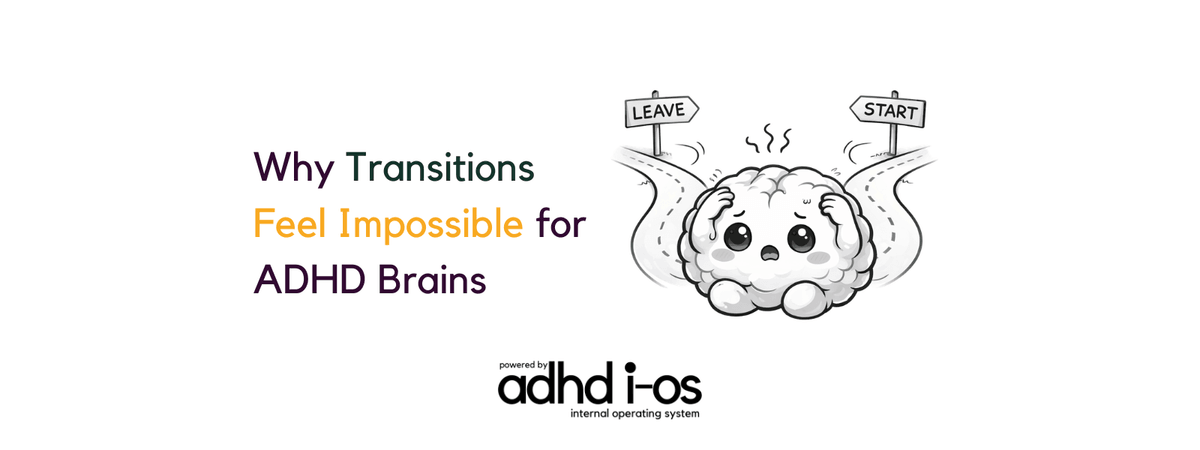
But instead, your body feels frozen. Not distracted. Not resistant. Just stuck, like your mind knows what it wants to do, but your body just won't listen.
It's terrifying (and shameful, if we're being honest); after all, it's just doing the next thing that you know how to do, but for some reason you can't. It’s a too-real feeling that a lot of people struggle with; however, here is the truth that matters: Difficulty with transitions in ADHD is a brain-based issue. It is not a motivation problem, an attitude issue, or a sign that you do not care.
This article explains why transitions are hard for ADHD brains and what actually helps.
What a “Transition” Really Means for the Brain
A transition is often described as stopping one thing and starting another. But that description misses what the brain is actually doing.
From a neurological perspective, a transition involves several steps that happen close together.
- The brain has to disengage attention from the current task. That means letting go of focus, stimulation, and momentum.
- It has to shift focus toward something new. This includes deciding what comes next and orienting attention in a different direction.
- The brain has to reinitiate effort. That means activating energy, motivation, and working memory again.
Each of these steps relies on executive function. Executive function includes skills like task switching, initiation, planning, and cognitive flexibility. In ADHD, these systems are already working with fewer resources.
So even when both tasks are simple, the transition between them can feel overwhelming. Transitions are cognitively expensive, not because the person is difficult, but because the brain is doing a lot of invisible work.
Why ADHD Brains Pay a Higher Switching Cost
In ADHD, executive function does not switch gears smoothly. Research shows that ADHD brains often need more energy to stop an engaging task, evaluate what comes next, and restart focus. This is sometimes referred to as a higher “switching cost.”
A useful way to picture this is a device with a low battery. Each app switch drains power. Each restart takes time. If the battery is already low, switching apps feels harder than staying where you are.
For ADHD brains, this cost shows up most clearly when:
- Leaving something interesting or stimulating
- Starting something vague or emotionally loaded
- Switching under time pressure
This has nothing to do with laziness or effort. Neuroimaging studies consistently show differences in prefrontal cortex activation and dopamine signaling in ADHD. These systems are essential for initiating and switching tasks.
If dopamine levels are low or inconsistent, the brain struggles to generate the internal “go” signal needed to move on. That is why transitions often feel physically difficult, not just mentally inconvenient.
What Transitions Feel Like From the Inside
From the outside, transition difficulty can look confusing. From the inside, it often feels very specific and very real.
Many ADHD adults describe:
- Feeling glued to the chair
- A sudden wave of fatigue when they try to switch
- Irritability or emotional numbness
- Avoidance that sounds like “I’ll do it in a minute.”
That “minute” is not an intentional delay. It is often the brain waiting for enough activation to move. Frustration builds, guilt follows, then overwhelm sets in. The longer the delay lasts, the harder it becomes to start, because now emotions are also draining executive function.
This is why transitions can trigger shutdown rather than action. It forces your nervous system to pause, which triggers an entire physical shutdown that seems like laziness to those not in the know.
Why Pressure and Shame Make Transitions Worse
When someone is rushed, criticized, or shamed, the nervous system shifts into stress mode. Stress and pressure reduce access to executive function. That means the very skills needed to transition become less available. Comments like “just finish it” or “why can’t you move on” are often meant to help.
But for ADHD brains, they increase urgency without increasing capacity. Under pressure, the brain focuses on threat rather than planning. This makes it harder to disengage attention, harder to decide what comes next, and harder to initiate movement.
Over time, repeated shame around transitions can condition the brain to associate switching tasks with anxiety. That makes future transitions even more difficult.
Support does not mean removing expectations. It means lowering unnecessary stress so the brain can function.
What Actually Helps ADHD Brains Transition (And How Others Can Support It)
What helps ADHD brains transition is not willpower. It is structure, predictability, and reduced cognitive load.
Advance warnings give the brain time to prepare, while sudden demands force an abrupt shift that is harder to execute. Clear time markers work better than urgency because they provide information instead of pressure.
Breaking transitions into a single next step lowers overwhelm and helps momentum restart. Support from others becomes most effective when it reduces emotional pressure and clarifies what comes next instead of rushing the outcome.
Practical supports that help:
- Give advance warnings so the brain can prepare for the switch.
- Use time markers instead of ultimatums to reduce stress.
- Externalize time with timers or written reminders.
- Add brief movement between tasks to reset attention.
- Identify one clear next step rather than the whole task.
- Ask clarifying questions instead of demanding completion.
These are not crutches. They are accessibility tools that help ADHD brains work with their neurology instead of against it.
It’s Not Resistance. It’s a Brain Lag.
Transitions are not hard because someone with ADHD does not want to move on. They are hard because transitions require multiple executive function shifts at once.
When those shifts are rushed or emotionally charged, the brain stalls. When they are supported with time, clarity, and understanding, the brain comes back online more quickly.
This is why pressure rarely helps and why compassion does.
With the right supports, ADHD brains can transition more smoothly, with less friction and less shame. Energy returns faster. Focus stabilizes sooner. And the cycle of frustration begins to loosen.
When transitions are treated as a neurological challenge rather than a personal failure, everyone benefits. Understanding replaces conflict. Support replaces blame. And the next step becomes possible again.
Strengthening the adhd i-os
Transitions are not about forcing yourself to move faster or care more. They are about supporting the system your brain already runs. When transitions are structured and predictable, the brain spends less energy fighting the switch and more energy re-engaging with what comes next.
Small, repeatable supports create smoother handoffs between tasks and reduce the friction that drains focus and confidence. With the right tools, momentum returns sooner and recovery takes less effort.
Looking for more support for your i-os? Read more neuroscience-grounded tools in NeuroSpicy Weekly, and join the adhd i-os community if you want to learn and practice alongside others who get it.