

The Hidden Cost of Constant Pressure on ADHD Brains
The Hidden Cost of Constant Pressure on ADHD Brains
The Hidden Cost of Constant Pressure on ADHD Brains
For many ADHDers, life can feel like one long performance review. Too loud. Too emotional. Too distracted. Try harder. Do better next time.
From an early age, feedback piles up about behavior, attention, tone, effort. Even when it’s meant to help, the message slowly solidifies: something about you is the problem.
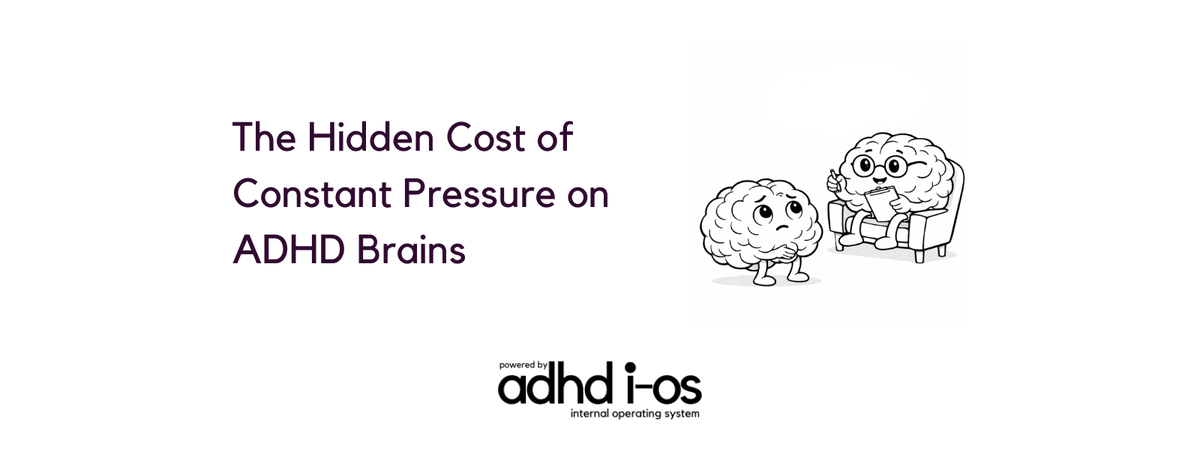
This article isn’t about how therapy “fixes” ADHD. It’s about something quieter and more consequential: how constant pressure reshapes the ADHD nervous system, and how the right kind of therapy removes that pressure so real change can finally happen.
How ADHDers Learn to Run on Pressure
Growing up with ADHD often means growing up under correction.
“You’re so smart, if you’d just focus.”
“Why can’t you sit still?”
“You’re overreacting.”
Over time, those moments teach a dangerous lesson: you must monitor yourself constantly.
As adults, that pressure turns inward. “I’ll get my life together this time” becomes a fear-driven project powered by anxiety about messing up, being too much, or disappointing people again. Motivation comes less from interest or safety and more from threat.
Most ADHDers aren’t under-motivated. They’re over-pressured.
Fear Works (Until It Doesn’t)
Pressure can create short bursts of productivity. Panic before a deadline can unlock all-nighters. People-pleasing at work can look like high performance. Over-functioning in relationships can feel like stability.
But fear is an expensive fuel source.
Chronic tension builds. Sleep gets disrupted. Emotional reactions intensify. Eventually the system overloads, and shutdown becomes the only option left. What looks like procrastination or “laziness” from the outside is often nervous system exhaustion on the inside.
Brains with ADHD already exhibit differences in executive function and emotional regulation, and chronic stress further impairs these systems instead of strengthening them.
Pressure keeps you moving, but it drains the brain that has to carry it.
When Everything Turns Into a Test
Under constant pressure, ordinary moments start carrying moral weight. Lost keys aren’t just lost keys; they’re proof you’re irresponsible. A delayed reply becomes evidence you’re a bad friend. An emotional reaction confirms, once again, that you’re “too much.”
You’re running a different operating system, but instead of learning how it works, you’re stuck trying to suppress it. The question shifts from “How does my system function?” to “How do I make it stop being like this?”
Living that way keeps the brain in threat mode.
What Therapy Changes When It’s Done Right
ADHD-informed therapy doesn’t start by pushing you to perform better. It starts by removing the assumption that you are the failure point.
You bring in the stories you’re most ashamed of and instead of “try harder,” you hear: Of course this makes sense given your wiring. Let’s look at the pattern.
Three subtle but powerful shifts follow.
First, blame turns into pattern recognition. Emotional blowups become signals of overload, not personal defects.
Second, character judgments turn into system conversations. “I’m a disaster” becomes “my brain does this under stacked stress. What support reduces that?”
Third, criticism gives way to curiosity. Instead of asking why you’re broken, you start asking what your system needs.
Why Less Pressure Improves Function
As that shift settles in, the nervous system begins to calm. When mistakes are no longer treated as threats, the brain exits fight-or-flight more often.
Before therapy, every task feels like a referendum on your worth. Every emotional spike feels like confirmation that you’ve failed again.
After pressure loosens, tasks become tasks. Emotions become information. Mistakes become data instead of indictments.
Research on emotional dysregulation in ADHD shows that when shame and threat decrease, regulation capacity improves over time. This supports flexibility, recovery speed, and follow-through, preventing collapse.
What Actually Changes
From the outside, it can look like you’re doing less. Fewer dramatic resets. Fewer all-or-nothing plans to reinvent your life.
Under the hood, the system is finally running without constant error messages. You build smaller, more sustainable supports. Bad days don’t spiral as far because they’re no longer moral failures. You say no more often because safety isn’t tied to overperforming.
The change isn’t that you wake up as a different person. It’s that you stop living like you’re one mistake away from losing everything.
The Real Cost of Pressure on ADHD Brains
The hidden benefit of good therapy isn’t motivation or productivity; it’s relief. When you’re no longer living under constant self-surveillance, your system finally has room to regulate, experiment, and recover.
If you want a starting point, notice where your motivation is coming from this week. Fear, or support? Try letting one thing stop being a test.
When pressure eases, what’s left isn’t laziness. It’s space to rest, to learn your system, and to build a life that fits your adhd i-os.
Did this resonate with you? We got more where that came from! Read the NeuroSpicy Weekly for more writing that reduces pressure instead of adding to it. And join us on Instagram for more “oh wow, that’s my brain” moments.