

ADHD and Sensory Soothing: How You Calm Your Overloaded Brain
ADHD and Sensory Soothing: How You Calm Your Overloaded Brain
A lot of ADHD sensory habits only become noticeable after someone points them out.
You might realize you've spent an entire phone call pacing around the kitchen. Or that you've listened to the same song on repeat for most of the afternoon. Maybe you're always reaching for a hoodie, chewing gum while you work, rubbing the edge of a blanket, or turning on background noise before you can concentrate.
Most people have sensory preferences. The difference is that for many ADHDers, these preferences often show up with surprising consistency. Certain sounds, textures, movements, or sensations seem to make thinking easier. Others can make focus disappear almost instantly.
That's because attention doesn't exist in isolation. It operates inside a nervous system that is constantly adjusting to the environment around it. Noise levels, visual input, physical movement, emotional stress, and sensory stimulation all influence how regulated or overwhelmed that system feels.
Research from the Child Mind Institute and the Cleveland Clinic suggests that ADHD affects far more than attention alone. Differences in sensory processing, attention regulation, and nervous system activation can influence how people experience the world around them.
Many of the behaviors people describe as sensory soothing are less about comfort than they are about regulation. They are often small adjustments that help the nervous system maintain a level of stimulation where attention, emotion, and focus become easier to manage.
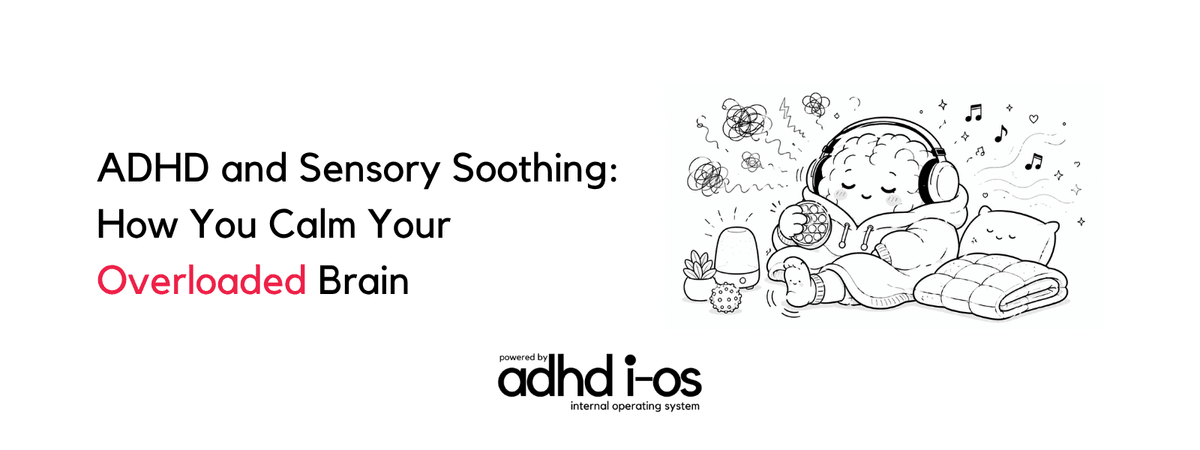
ADHD, Sensory Processing, and Overload
Every moment of the day, your nervous system is sorting through an enormous amount of information.
Conversations happening nearby. Notifications buzzing on a phone. Music playing in the background. The texture of clothing against your skin. Lighting, temperature, movement, and dozens of other inputs that most people rarely think about consciously.
The brain's job is not just to notice this information. It also has to decide what deserves attention and what can safely fade into the background.
For many ADHDers, that filtering process can be inconsistent.
The University of Rochester Medical Center and the STAR Institute describe sensory processing as the way the nervous system receives, organizes, and responds to incoming information. When that process becomes overloaded, ordinary environments can start feeling surprisingly demanding.
This is where many ADHD overstimulation symptoms begin to appear.
A noisy restaurant may feel manageable for the first hour and exhausting by the second. A busy office can gradually become harder to think in as conversations, movement, notifications, and mental demands accumulate throughout the day.
Often it isn't one sensory input causing the problem.
It's the accumulation.
Many ADHDers describe reaching a point where everything suddenly feels louder, brighter, or more irritating than it did earlier. The environment hasn't necessarily changed. What has changed is the amount of processing the nervous system has been doing behind the scenes.
When that load becomes too heavy, the brain starts looking for ways to regain balance.
The Nervous System and Sensory Regulation
One reason sensory soothing feels so automatic is that much of it happens before conscious decision-making gets involved.
People rarely stop and think, "I need exactly seventeen minutes of pacing right now." They simply notice that moving helps them think. Or that putting on headphones makes a task feel easier to start. Or that a weighted blanket helps their body settle after a long day.
These behaviors often emerge because the nervous system is constantly monitoring stimulation levels and making adjustments. Sometimes attention starts drifting because there isn't enough stimulation. Other times the environment becomes so demanding that the nervous system starts searching for ways to reduce the load.
Harvard Health has written extensively about how the body responds to stress and stimulation, while the University of Washington's ADHD resources discuss the regulation challenges that frequently accompany ADHD. Sensory input becomes one of the tools available for managing those shifts.
Movement can increase alertness when attention begins fading. Predictable sounds can reduce the effort required to process a noisy environment. Pressure, texture, or repetitive sensory experiences can provide a sense of stability when everything else feels scattered.
The common thread isn't the specific behavior. It's the effect the behavior has on regulation. Many ADHD sensory habits persist because, on some level, they work.
This is a core part of ADHD nervous system regulation. The nervous system is constantly trying to maintain a workable level of stimulation, and sensory input often becomes part of that balancing act.
Why Repetitive Sensory Input Feels Calming
One of the most common sensory regulation patterns in ADHD involves repetition.
The same playlist.
The same movement.
The same sound.
The same sensory experience over and over again.
At first glance, repetition seems like it should become boring. Yet many ADHDers find themselves returning to familiar sensory experiences when they're stressed, overwhelmed, or trying to focus.
Part of the reason is predictability.
When sensory input becomes familiar, the nervous system spends less energy monitoring it. There are fewer surprises. Less uncertainty. Less demand on already stretched attention systems.
Examples might include:
- replaying a favorite song repeatedly
- pacing while brainstorming
- tapping a rhythm during work
- chewing gum while concentrating
- rocking gently while reading
- repeatedly touching a familiar texture
These behaviors create a stable source of input in environments that often feel unpredictable.
Rather than competing for attention, the sensory experience can provide a steady background rhythm that makes everything else easier to process.
Sensory Seeking vs. Sensory Avoidance
One of the more confusing aspects of ADHD sensory regulation is that people often experience both sensory seeking and sensory avoidance.
Sometimes within the same day.
A person may enjoy loud music during a workout but become overwhelmed by multiple conversations at dinner. They may seek movement during a workday but avoid crowded events. They may love the pressure of a weighted blanket while finding certain clothing textures unbearable.
These experiences can seem contradictory until you look at them through the lens of regulation.
The goal is rarely stimulation for its own sake.
The nervous system is trying to find the level of input that feels manageable.
Research from Temple University and the STAR Institute suggests that sensory regulation often involves moving between under-stimulation and overstimulation. When either extreme becomes uncomfortable, the nervous system starts searching for ways to restore balance.
This is why ADHD sensory seeking behavior can look inconsistent from the outside. The need isn't always for more stimulation or less stimulation. The need is for the right amount.
How Sensory Soothing Shows Up in Daily Life
Many sensory regulation habits become so automatic that people stop noticing them.
They simply become part of how work gets done, how stress is managed, or how focus is maintained.
Examples include:
- needing headphones to concentrate
- replaying one song repeatedly
- pacing during phone calls
- rubbing textures unconsciously
- using background noise while working
- fidgeting during meetings
- reaching for pressure through blankets or oversized hoodies
These habits often support concentration, emotional regulation, and productivity in subtle ways.
The University of Washington's ADHD resources highlight how self-regulation strategies frequently become part of everyday life for ADHD brains.
Many people don't consciously decide to use these strategies. They discover them through experience because they help.
In some cases, the difference between staying focused and losing focus entirely can be something as simple as having the right sensory environment.
Why These Behaviors Are Often Misunderstood
Sensory soothing behaviors can be easy to misread.
Someone wearing headphones may be assumed to be tuning out. Someone fidgeting may appear distracted. Someone pacing might look restless or unfocused.
The reality is often more complicated.
Many of these behaviors help support attention rather than interfere with it. They reduce competing demands on the nervous system or provide enough stimulation to help maintain focus.
The Child Mind Institute and Cleveland Clinic both note that sensory regulation challenges can influence behavior in ways that are not always obvious to other people.
When those behaviors are misunderstood, many ADHDers begin masking them. They stop using strategies that help because they worry about appearing distracted, immature, or different.
Unfortunately, removing a regulation tool doesn't remove the regulation need.
It simply makes the job harder.
Reframing Sensory Soothing
A useful question is not whether a sensory habit looks unusual. A more useful question is what role it might be playing.
The repeated song, the pacing, the background noise, the fidget, the headphones, or the familiar hoodie may all be serving different purposes. What they often share is an ability to influence how regulated, focused, or emotionally steady the nervous system feels.
ADHD brains spend much of the day navigating a narrow space between overstimulation and understimulation. Too much input can feel overwhelming. Too little can make focus nearly impossible to sustain. Sensory soothing behaviors often emerge as practical attempts to stay somewhere in the middle.
Understanding that can change how these habits are interpreted. Instead of viewing them as distractions to eliminate, it becomes possible to see them as information. They offer clues about what helps the nervous system function more effectively.
The goal is not to force every behavior to disappear. The goal is to understand why it exists in the first place. Once that becomes clear, it is much easier to build environments, routines, and systems that support the way an ADHD brain naturally operates.
When the Brain Uses Sensation to Regulate
Many ADHD sensory habits make more sense once you stop asking whether they're productive and start asking what they're helping you manage.
The answer is often surprisingly practical.
The repeated song may be helping reduce competing distractions. The pacing may be helping organize thoughts. The headphones, fidget, background noise, or weighted blanket may be giving the nervous system exactly the level of stimulation it needs to stay regulated.
These behaviors are not random. They are often part of an ongoing effort to balance attention, emotion, and sensory input throughout the day.
Understanding that can reduce a great deal of unnecessary shame. What looks like a habit on the surface may actually be a useful piece of information about how your nervous system functions best.
Inside adhd i-os, we explore the neuroscience behind attention, sensory regulation, executive function, and everyday ADHD experiences so readers can better understand the patterns that shape how their brains work.