

ADHD and Over-Commitment: Why Saying Yes Feels Automatic
ADHD and Over-Commitment: Why Saying Yes Feels Automatic
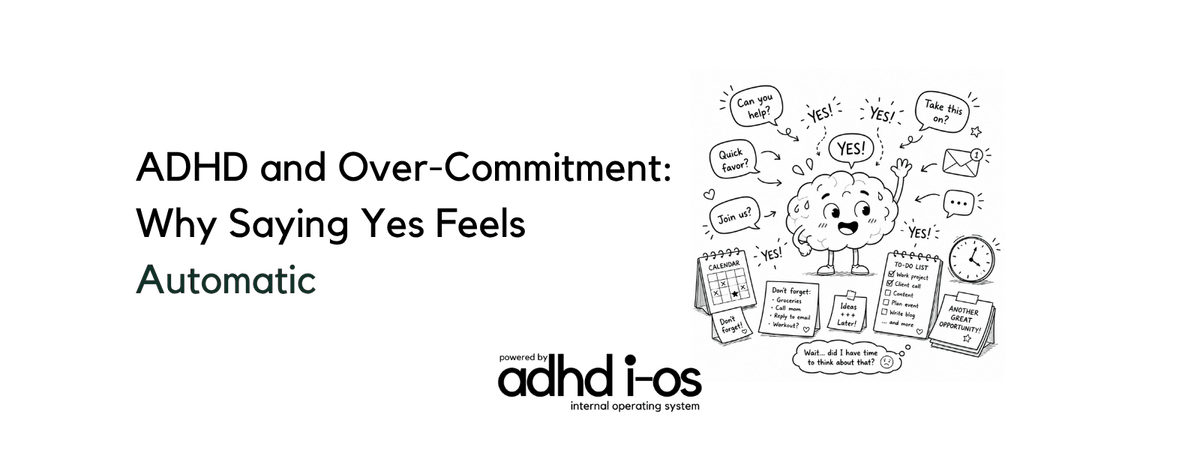
Someone asks if you can help with a project. Sure. A friend invites you to an event next weekend. Absolutely. A new opportunity lands in your inbox. Sounds great.
Then, three days later, you look at your calendar and remember the deadlines you already have, the errands you forgot about, the promises you made last week that suddenly feel much bigger than they did when you agreed to them.
Somewhere in the middle of that realization comes a familiar question: Why did I say yes to all of this?
For many ADHDers, over-commitment isn't a rare mistake. It's a recurring pattern.
And the frustrating part is that the commitments often felt completely reasonable when you made them. In the moment, saying yes feels natural, sometimes even obvious.
That's why it's tempting to attribute this to poor planning, people-pleasing, or a lack of discipline. But the story is more complicated.
Research from the Cleveland Clinic and the National Institute of Mental Health shows that ADHD affects decision-making, impulsivity, executive function, attention regulation, and reward processing, which are the exact same systems that shape how you evaluate opportunities in real time.
Which means saying yes isn't always the result of carefully weighing future capacity against present opportunity. Sometimes the opportunity arrives before the evaluation does.
Impulsivity and immediate responses
When most people hear "impulsivity," they picture reckless behavior, jumping off something, spending money you don't have.
But impulsivity also shows up in much smaller, quieter ways: responding before fully evaluating, agreeing before fully considering, committing before fully planning.
Research from the National Human Genome Research Institute shows that ADHD involves differences in how impulse regulation and behavioral control operate at a neurological level. In everyday terms, that often means the gap between thought and action is shorter.
An opportunity appears, a request is made, and a decision happens. Only afterward does the brain begin filling in the details.
This is why ADHD-related impulsive decisions around commitments feel so confusing in hindsight. The decision felt genuine because it was genuine. You probably did want to help. You probably were excited. You probably believed you could make it work.
The problem isn't that the intention was false. It's that the evaluation happened after the commitment instead of before it.
For many ADHDers, pausing long enough to forecast consequences requires deliberate effort. Without that pause, the brain naturally responds to what feels most relevant right now, and right now, the opportunity feels exciting.
The scheduling conflict three weeks out doesn't compete equally for your attention. The energy you'll need next Thursday doesn't either.
So "yes" arrives before you've finished asking the questions that might have led to a different answer.
Reward sensitivity and opportunity bias
ADHD brains tend to be highly responsive to reward, novelty, and possibility, and that's not just a personality trait. It's tied to how motivation and dopamine systems operate.
Research on how dopamine shapes reward and reinforcement suggests that ADHD brains often respond more strongly to immediate rewards and exciting possibilities than to distant outcomes.
This helps explain why opportunities can feel unusually compelling.
A new project isn't just a project, it's possibility. A new commitment isn't just another obligation, it's potential. The opportunity carries excitement before any actual work has begun. For many ADHDers, saying yes creates an immediate sense of momentum. The brain gets a burst of stimulation just from imagining what could happen.
That response creates a kind of opportunity bias: the benefits feel vivid, the costs feel abstract. The exciting outcome is easy to picture, while the calendar collision three weeks from now is much harder to see.
The brain isn't evaluating a commitment and a consequence on equal footing. It's weighing an exciting opportunity against a future responsibility that doesn't fully feel real yet.
Excitement tends to win that comparison by a wide margin.
Time blindness and future underestimation
One of the biggest contributors to ADHD over-commitment is time blindness, which is the difficulty accurately estimating duration, anticipating future workload, and mentally projecting yourself forward into next week or next month.
When someone asks whether you can do something next month, your future schedule feels wide open. When next month arrives, it turns out it was never wide open at all. It just looked less crowded from a distance.
A project that will realistically take eight hours feels like a two-hour task.
A week that's already full still appears to have breathing room.
Three commitments made separately feel manageable right up until they arrive at the same time.
Research on ADHD and time perception consistently shows that estimating future demands is harder for ADHD brains, not because of a lack of intelligence, but because future information carries less weight than present information.
The opportunity exists now. The workload exists later. That's why so many ADHDers genuinely believe they can fit everything in. At the moment they agree, it actually feels true.
Executive function and planning gaps
Good planning is more complicated than most people realize. It requires forecasting, prioritizing, comparing trade-offs, and keeping multiple future commitments active in working memory at the same time.
Harvard's Center on the Developing Child describes executive function as the system responsible for organizing behavior, managing priorities, and regulating actions toward future goals, and for ADHD brains, those systems can be less consistent.
That inconsistency tends to surface during commitment decisions. A new opportunity gets evaluated in isolation rather than as part of a larger picture.
The brain sees the request and sees the opportunity, but doesn't automatically pull every competing responsibility into awareness at the same time. So the decision gets made without a full view of what's already on the plate.
The issue is visibility, not willingness.
Future obligations are often sitting just outside conscious awareness when the commitment is being made. And if you can't easily see the whole workload, it's a lot easier to add one more thing.
Emotional and social drivers
Not every over-commitment starts with excitement. Sometimes it starts with connection.
Many ADHDers genuinely enjoy helping people. They care deeply about relationships and feel energized by shared experiences. That makes saying no surprisingly uncomfortable.
A request comes in, someone needs help, a friend wants support, and the emotional pull arrives immediately. Waiting to respond feels awkward. Declining can feel even worse.
Research on emotion and decision-making shows that emotional intensity shapes choices in ways that often bypass deliberate reasoning.
The desire to help is real. The desire to avoid disappointing someone is real. The excitement of connection is real.
And all of those signals are firing before the brain has fully evaluated future capacity. That combination can make over-commitment feel less like a choice and more like a reflex.
How over-commitment shows up
In the moment, ADHD over-commitment rarely looks like a problem. It looks like enthusiasm, generosity, someone who's motivated and willing to show up.
Then later it starts to look like too many projects, an overbooked schedule, last-minute cancellations, and the constant feeling of running behind.
Over time, the pattern touches work performance, relationships, personal time, energy, and stress in ways that compound on each other.
Many ADHDers spend years blaming themselves for these struggles without recognizing how many different brain systems are involved. The issue is often much bigger than not managing time well enough.
The ADHD over-commitment loop
Most ADHDers can recognize some version of this cycle:
- An opportunity appears
- Excitement kicks in
- A yes gets said
- Time passes, responsibilities pile up
- Stress builds
- The next exciting opportunity shows up
- Repeat
What makes it hard to interrupt is that each step feeds the next. The more overwhelmed someone becomes, the more appealing a fresh start can feel, because new opportunities bring back that sense of momentum and possibility.
The escape from overwhelm and the source of future overwhelm are often the same thing.
Reframing the behavior
Over-commitment is usually treated as a responsibility problem. For many ADHDers, it's really a forecasting problem.
The brain is making decisions with incomplete information. Reward systems prioritize opportunity. Time blindness minimizes future workload. Executive function struggles to hold every competing commitment in awareness at once.
The result is a mismatch between what a decision looks like in the moment and what it actually demands later.
Understanding that doesn't make the consequences disappear. But it does replace a lot of unnecessary self-blame with a more accurate picture of what's actually happening, and that's a more useful place to work from.
When "yes" happens too fast
Most people evaluate commitments by whether they were fulfilled. ADHDers often benefit more from looking one step earlier: what happened right before the yes?
Was there excitement? Urgency? Emotional pressure? A future workload that was hard to picture?
The answers there usually explain far more than the commitment itself.
ADHD brains tend to notice opportunity before limitation, excitement before effort, and present rewards before future constraints. That same tendency can produce real creativity, generosity, and enthusiasm, and calendars that feel genuinely impossible to survive.
Understanding how impulsivity, reward sensitivity, time blindness, and executive function shape your commitments doesn't fix everything overnight. But once you understand the mechanism, you can start building systems that work with your brain instead of against it.
Inside adhd i-os, we dig into the neuroscience behind decision-making, motivation, executive function, and everyday ADHD experiences so you can better understand how your brain actually works in real life.