

ADHD and Decision-Making Under Stress: What the Brain Does
ADHD and Decision-Making Under Stress: What the Brain Does
You know what you should do.
You have thought through the options. You understand the consequences. You can even explain exactly why one choice is better than another.
Then the stressful moment arrives.
And suddenly you do something completely different.
You send the text you planned to wait on. You agree to something you did not want to commit to. You make a purchase you already decided against. You react before thinking and spend the next few hours wondering why you ignored everything you knew just moments earlier.
For many ADHDers, this experience is frustratingly familiar.
It can feel like your judgment disappears under pressure. Like your ability to think clearly vanishes the moment emotions become involved.
But ADHD decision making under stress is not simply a matter of poor judgment or lack of self-control.
Stress changes how the brain functions.
And when ADHD is already affecting executive function, emotional regulation, and impulse control, those changes can become even more noticeable.
The result is often a version of yourself that feels very different under pressure than you do when calm.
Understanding what is happening inside the brain helps explain why decisions that seem obvious in hindsight can feel impossible to access in the moment.
The ADHD Brain and Executive Function
Every decision relies on executive function.
Executive functions are the brain's management systems. They help you plan ahead, compare options, pause before reacting, evaluate consequences, and stay focused on long-term goals.
Without executive function, decision-making becomes much more reactive.
The Harvard Center on the Developing Child describes executive function as the collection of mental processes that allow people to regulate behavior, prioritize information, and manage complex tasks. These skills are essential anytime you need to slow down and think before acting.
For ADHD brains, executive function can be less consistent.
That does not mean these abilities are missing. It means access to them can fluctuate depending on stress, stimulation, fatigue, environment, and emotional state.
On a calm day, a decision may feel straightforward.
During a stressful day, the exact same decision can suddenly feel overwhelming.
The effects become much easier to notice when pressure enters the picture.
Most ADHDers already know what a good decision looks like. The challenge is maintaining access to the systems that help evaluate options, slow down reactions, and think beyond the immediate moment.
When executive function becomes harder to access, the brain naturally leans more heavily on emotion, urgency, and short-term relief.
And that shift becomes especially important once stress enters the picture.
What Stress Does to the Brain
Stress changes how the brain allocates resources.
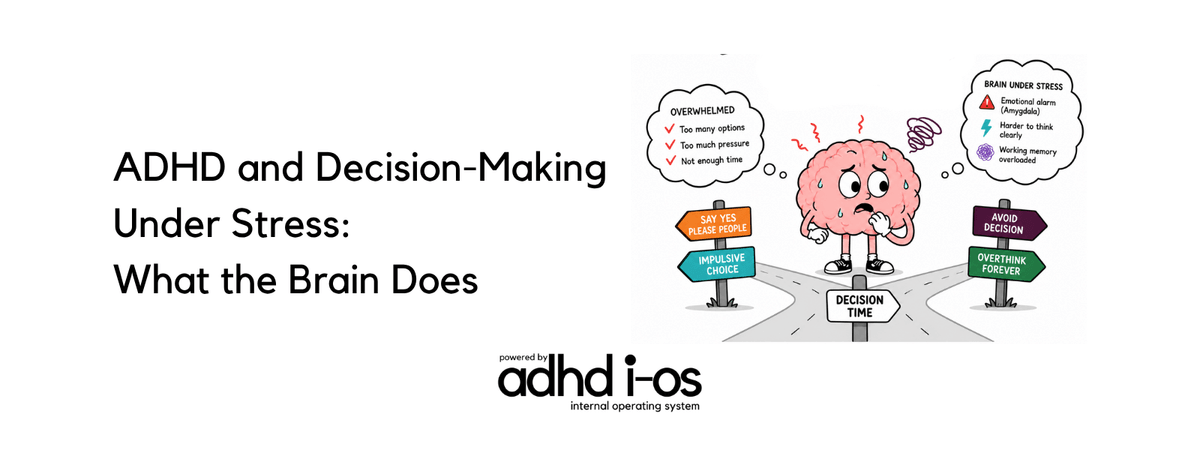
When the brain detects pressure, uncertainty, conflict, or perceived danger, it begins shifting toward survival-oriented processing. The goal becomes responding quickly rather than thinking deeply.
This response is useful in emergencies.
It becomes less helpful when the threat is a difficult conversation, a work deadline, or an emotionally charged decision.
The National Institute of Mental Health and Harvard Health Publishing have both written extensively about how stress affects brain function. Under stress, systems involved in emotional processing become more active while higher-level cognitive systems become less accessible.
This is a critical part of the ADHD stress response brain pattern.
The brain starts prioritizing immediate action over deliberate analysis.
Long-term consequences become harder to evaluate.
Future outcomes feel less real.
The urge to solve the discomfort right now becomes stronger.
For ADHD brains, this shift can feel particularly intense because executive function was already working harder to maintain regulation before the stress occurred.
Think of it like trying to run a complicated software program on a computer that is already using most of its processing power.
Once stress arrives, there is even less capacity available.
That is often the moment when thoughtful decision-making starts becoming reactive decision-making.
The Prefrontal Cortex vs. the Emotional Brain
A large part of decision-making happens in the prefrontal cortex.
The prefrontal cortex is responsible for reasoning, impulse control, planning, judgment, and evaluating consequences.
It helps answer questions like:
- What happens if I do this?
- What happens if I wait?
- Is this aligned with my long-term goals?
- What are the possible outcomes?
Meanwhile, the amygdala plays a different role.
The amygdala is heavily involved in emotional processing, threat detection, and rapid responses to stress.
Both systems are important.
Problems arise when one begins overpowering the other.
Under stress, the amygdala becomes more active while the prefrontal cortex becomes less effective.
Research discussed by the National Institute on Drug Abuse shows that stress can significantly influence decision-making by altering how different brain systems communicate.
For ADHD brains, that imbalance can become much more noticeable.
Emotional systems start taking on a larger role while the prefrontal cortex has fewer resources available for planning, evaluation, and impulse control.
The logical part of the brain is still there.
It just has a quieter voice than it did five minutes ago.
Many ADHDers recognize this feeling immediately.
They know the logical choice.
They just cannot access it consistently while emotionally activated.
Why ADHD Decisions Become Impulsive Under Stress
Stress and ADHD create a combination that naturally increases impulsivity.
When executive function becomes less available and emotional activation rises, the brain becomes more focused on immediate relief.
That combination naturally pushes decisions toward immediate comfort.
The faster a choice reduces discomfort, uncertainty, or emotional tension, the more attractive it can become in the moment.
Someone may:
- send a message without thinking it through
- agree to something under pressure
- spend money impulsively
- avoid a difficult task
- react emotionally during conflict
In many cases, the decision makes sense in the moment because it reduces discomfort.
The problem is that immediate relief and long-term benefit are not always the same thing.
The American Psychological Association has written extensively about how stress affects behavior and increases reactivity. Under pressure, people often rely on faster, less deliberate decision-making processes.
For ADHD brains, that tendency can become even more pronounced.
The result is often a decision that feels right in the moment and confusing afterward.
Emotional Intensity and Decision Pressure
Emotions play a powerful role in ADHD decision-making.
ADHD is associated with differences in emotional regulation, including stronger emotional responses and faster escalation under stress.
When emotions become intense, they start influencing decisions more heavily.
The decision may feel urgent.
The situation may feel bigger.
The consequences may feel immediate.
And because stress is already reducing access to executive function, emotions begin carrying more weight than they otherwise would.
This is why many ADHDers experience a pattern where logic arrives after the decision rather than before it.
The emotional response happens first.
Reflection comes later.
Research from the American Psychological Association and the University of Michigan has explored how emotional states influence behavior and cognitive processing. When emotional intensity rises, decision-making becomes more dependent on those emotional signals.
That does not mean emotions are bad information.
It simply means they are not always complete information.
How This Shows Up in Real Life
Most ADHD decision-making struggles are not happening during major life events.
They happen during ordinary moments.
A disagreement with a partner.
An urgent email.
A financial decision.
A work deadline.
A last-minute request.
A stressful conversation.
Under pressure, many ADHDers find themselves:
- making decisions faster than intended
- agreeing to commitments they later regret
- struggling to think clearly during conflict
- avoiding difficult choices entirely
- choosing short-term relief over long-term goals
These patterns can affect:
- work performance
- relationships
- finances
- time management
- self-confidence
Over time, repeated experiences like these can create a frustrating cycle where stress increases decision problems, which then creates even more stress.
The ADHD Stress-Decision Loop
Many ADHDers experience a repeating cycle that looks something like this:
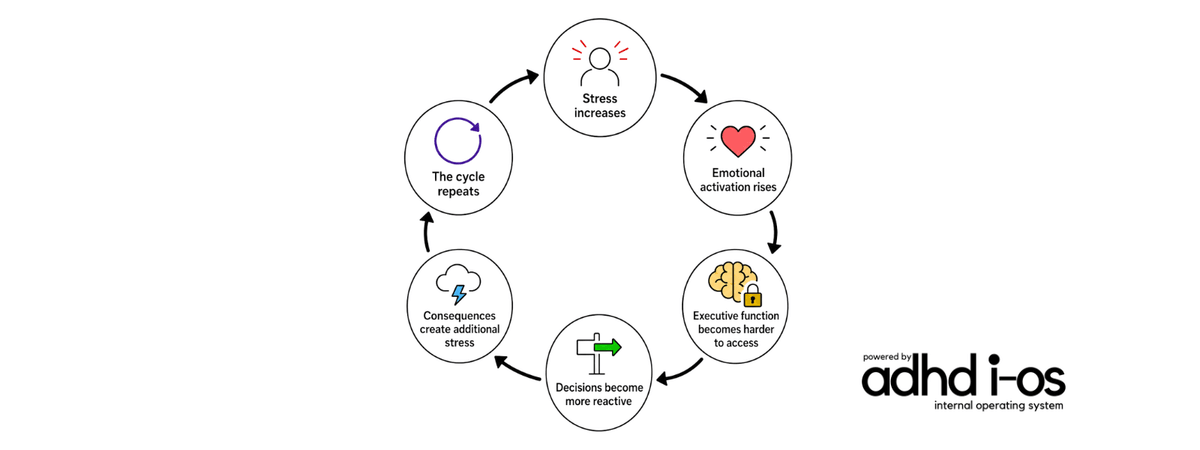
The frustrating part is that each stage reinforces the next.
The more stressed the brain becomes, the harder it is to access the very systems needed to make effective decisions.
Understanding this loop helps explain why decision-making challenges often feel cyclical rather than random.
Reframing Decision Struggles
Decision-making challenges in ADHD are often state-dependent.
A calm brain and a stressed brain do not have equal access to the same resources.
Harvard Health has written extensively about how stress affects cognition, memory, and reasoning. As stress rises, access to higher-level thinking decreases.
For ADHDers, that difference can be especially noticeable.
The difference is often whether those systems are available when you need them.
A calm brain has greater access to planning, impulse control, and emotional regulation. A stressed brain has to work much harder to reach those same resources.
The person has not changed.
The brain state has.
Understanding that does not eliminate the challenge.
But it does replace self-blame with a more accurate explanation of what is happening.
When Stress Changes the Way You Decide
Most people judge decisions based on outcomes.
ADHD brains often benefit from looking one step earlier and asking a different question:
What state was my brain in when I made that choice?
Was I regulated or overwhelmed?
Was I thinking through the decision, or reacting to the stress surrounding it?
The answer often explains far more than the decision itself.
Understanding how stress affects executive function does not eliminate difficult choices, but it does make those moments easier to navigate with awareness instead of self-blame.
Inside adhd i-os, we explore the neuroscience behind executive function, emotional regulation, attention, and everyday ADHD experiences so you can better understand how your brain works when it matters most.