

ADHD and Conversational Ping-Pong: Keeping Up with the Brain Jumps
ADHD and Conversational Ping-Pong: Keeping Up with the Brain Jumps
You’re in the middle of a conversation.
Somehow you started talking about work, jumped to penguins, circled through childhood memories, referenced three unrelated stories, and then realized the other person has absolutely no idea how you got there.
Meanwhile, your brain followed the entire path perfectly.
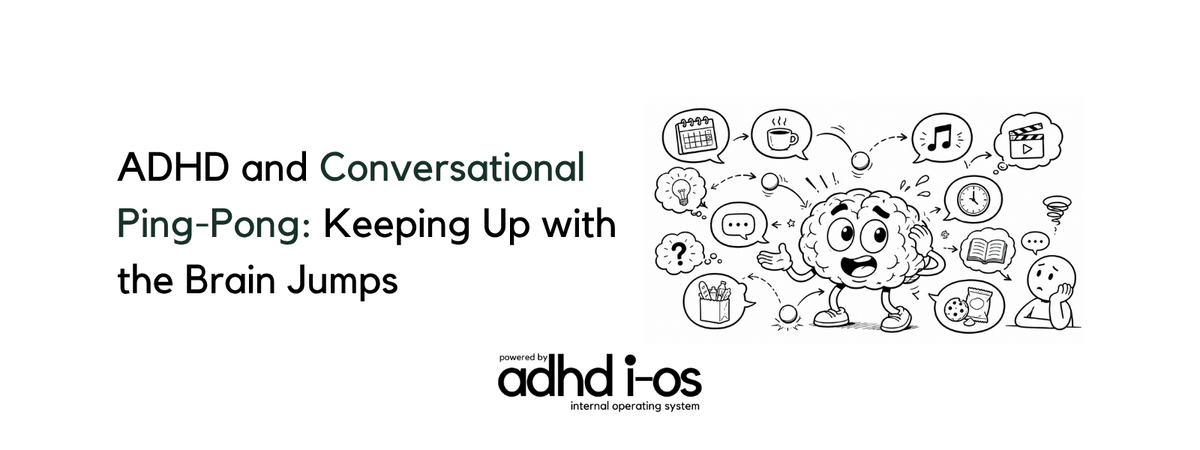
For many ADHD brains, conversations do not move in straight lines. They bounce. One thought triggers another. A single word sparks a memory, which connects to an idea, which reminds you of something emotionally relevant, which suddenly becomes part of the conversation too.
This kind of ADHD conversation jumping is often misunderstood as distraction, lack of focus, or not listening carefully enough. But for many ADHDers, the issue is not absence of attention.
It is movement of attention.
ADHD brains are often highly associative, meaning they rapidly connect ideas, memories, emotions, and observations in real time. Conversations can start feeling like conversational ping-pong because thoughts are tracking multiple connections simultaneously instead of following one clean conversational line.
The CDC and Yale Medicine both describe ADHD as involving differences in attention regulation, impulsivity, and executive functioning. Those same systems directly affect how conversations are processed, organized, and expressed.
Which means conversational jumping is not random.
Most of the time, the connections make complete sense internally.
Why ADHD Brains Jump Between Topics So Fast
ADHD brains tend to shift attention quickly.
Not always because focus disappears, but because thoughts move rapidly between associations. One idea naturally triggers another, and attention follows the connection before the previous thread has fully finished unfolding.
This is part of what creates ADHD attention shifting conversation patterns.
The National Institute of Mental Health describes ADHD as involving differences in attention regulation and cognitive control. In practice, that can mean attention moves dynamically rather than staying locked onto one conversational track for long periods of time.
For example, someone mentions coffee.
Your brain instantly connects:
- a café you visited last week
- the conversation you had there
- a podcast episode about caffeine
- the project you forgot to finish afterward
- the text message you still need to respond to
All of that can happen in seconds.
And because the connections feel immediately relevant internally, the conversation may suddenly jump outward before anyone else sees the pathway.
To the ADHD brain, the transition often feels obvious.
To everyone else, it can sound abrupt or disconnected.
That mismatch creates a lot of confusion in conversations, especially because ADHD conversational patterns are often happening faster than thoughts can be consciously organized.
Attention is not necessarily disappearing.
It is rapidly redirecting.
This is also why many ADHDers relate strongly to patterns explored in ADHD and the Shiny Object Syndrome, where attention naturally moves toward whatever feels most stimulating or mentally engaging in the moment.
Executive Function and Conversation Flow
Conversations rely heavily on executive functioning, especially the brain’s ability to organize thoughts, decide what matters most, and keep one conversational thread active long enough to communicate it clearly.
Executive functions help regulate sequencing, filtering, self-monitoring, and conversational pacing. They help determine what information feels most relevant, what order thoughts should come out in, and when the brain should pause before jumping to the next idea.
In ADHD, those systems can operate differently.
CHADD and Harvard’s Center on the Developing Child both describe executive functioning as the brain’s management system for organizing behavior and regulating attention. When executive function becomes overloaded, conversation flow can become more nonlinear.
This is where ADHD executive function communication challenges often start showing up.
Thoughts may arrive faster than they can be organized. Someone may begin explaining one point, remember another connected idea halfway through, and suddenly switch tracks before the original thought fully lands.
Multiple connected thoughts are often being processed simultaneously, which makes it harder to hold one clean conversational thread in place.
For many ADHDers, communication feels less like walking down a straight hallway and more like navigating an interconnected web of ideas in real time.
That can create conversations that feel energetic, layered, creative, and difficult for other people to follow all at once.
The mental overload that comes from constantly managing competing thoughts is also closely tied to what we explored in ADHD and Decision Fatigue, where the brain gradually loses bandwidth after processing too many inputs at once.
Why Interruptions Happen So Easily
Impulsivity affects conversations too.
A lot of ADHD impulsive talking patterns are connected to timing rather than intention. Thoughts can feel extremely temporary, which creates pressure to say them before they disappear.
That urgency changes conversational pacing.
Someone may interrupt before a thought is fully formed because waiting feels risky. By the time another person finishes speaking, the original thought may already be gone.
This creates overlapping conversations, interruptions, and fast-paced exchanges that are common in ADHD communication styles.
The CDC’s ADHD symptom overview and UCLA’s Program for ADHD and Related Conditions both note that impulsivity can affect conversational turn-taking and response inhibition. In real life, that often looks less like intentional interruption and more like someone trying to hold onto a rapidly fading thought while the conversation keeps moving.
For many ADHDers, there is an ongoing internal pressure of:
“Say it now before it disappears.”
That pressure shapes conversations constantly.
Working Memory and Losing the Thread
Working memory plays a huge role in conversational ping-pong.
Working memory helps temporarily hold information while the brain processes something else. In ADHD, working memory can become overloaded quickly, especially during fast-moving conversations.
Research from the National Institutes of Health has shown that ADHD is strongly connected to working memory differences, which helps explain why conversations can suddenly feel difficult to track internally.
Someone may lose track of what they were originally saying halfway through a sentence. Or they may abruptly jump topics because a new thought appeared and they are trying to preserve it before it disappears.
This is where many ADHD communication problems in conversation start showing up.
In many cases, the person is actually deeply engaged in the discussion while their attention rapidly tracks connected ideas underneath it.
The result is often:
- circling back later
- jumping between connected ideas
- forgetting the original point
- interrupting to “save” a thought
- changing topics mid-sentence
From the outside, it can look scattered.
Internally, it often feels like trying to keep multiple browser tabs from crashing at the same time.
That same “say it before it disappears” pressure also overlaps heavily with patterns discussed in ADHD and Info Dumping: The Brain’s Urgency to Share, especially when thoughts feel too temporary to hold internally for long.
How Conversational Ping-Pong Shows Up in Real Life
For many ADHDers, conversational jumping becomes especially noticeable in group settings, work meetings, and emotionally stimulating discussions.
A conversation may start in one place and branch outward rapidly. Someone may connect ideas other people do not see yet, then struggle to explain how they arrived there. Conversations may circle backward unexpectedly or shift topics before the previous thread feels complete.
This can affect:
- social interactions
- collaboration
- workplace communication
- meetings
- relationship dynamics
It can also create self-consciousness over time.
Many ADHDers become hyper-aware of their conversational patterns after repeated experiences of people looking confused, asking them to “slow down,” or assuming they were not paying attention.
That often leads to masking behaviors where people try to suppress their natural communication style completely.
Why Conversational Jumping Gets Misread
From the outside, ADHD jumping between topics can look like distraction or lack of interest.
But often the opposite is happening.
Many ADHD brains are deeply engaged in the conversation while simultaneously tracking emotional relevance, patterns, memories, and connected ideas underneath it.
Most conversations are socially expected to unfold in a straight line, with one topic staying active until it feels complete. ADHD conversational patterns rarely move that neatly.
Thoughts connect rapidly. Attention shifts dynamically. Conversations branch outward before other people see the connections forming.
When those differences are misunderstood, ADHDers often start over-monitoring their speech, second-guessing themselves, or masking their natural communication patterns entirely.
Over time, that becomes exhausting.
Reframing Conversational Ping-Pong
Conversational jumping is not always disorganized thinking.
Sometimes it is nonlinear thinking happening out loud.
A lot of ADHD brains are exceptionally fast at noticing patterns, generating associations, and connecting ideas across conversations. That can create communication styles that feel creative, energetic, emotionally layered, and occasionally difficult for others to track in real time.
CHADD has written extensively about ADHD strengths involving creativity, problem-solving, and rapid idea generation. Those same patterns often show up directly in conversations.
The challenge is not necessarily eliminating conversational ping-pong.
It is understanding what is actually happening underneath it.
Because once people understand that these patterns are connected to attention shifting, executive function, impulsivity, and working memory differences, the conversation changes completely.
Less shame.
Less self-blame.
More awareness of how the brain is actually operating.
When Conversations Move at Brain Speed
ADHD brains often move quickly.
Thoughts connect rapidly. Attention shifts dynamically. Conversations bounce because the brain is actively following associations, memories, emotions, and ideas all at once.
That does not mean the person is careless, distracted, or not listening.
It means the conversation is moving at brain speed.
Understanding that difference reduces a huge amount of misunderstanding and self-criticism. It also creates space for ADHDers to stop viewing every conversational jump as failure and start recognizing it as part of how their brain processes the world.
Inside adhd i-os, we explore the neuroscience behind ADHD communication, attention, emotional intensity, and everyday brain patterns in ways that actually feel relatable to live with.