

How Dopamine Drives Hyperfocus in ADHD
How Dopamine Drives Hyperfocus in ADHD
You can't make yourself open the spreadsheet. You've reread the first line four times and it still hasn't landed. An hour later, you're four videos deep into something you didn't plan to watch, fully absorbed, and you couldn't have stopped if you tried.
The Same Brain That Can't Start Can't Stop
Same brain. Same day. Two completely different stories, and neither one feels like a choice while it's happening.
Here's the part that makes it so confusing: the spreadsheet loses to something more interesting, not something more important, and your brain isn't weighing those two the way you'd expect. Importance sits in a file it can see but doesn't reach for. Interest sits right in front of it, pulling.
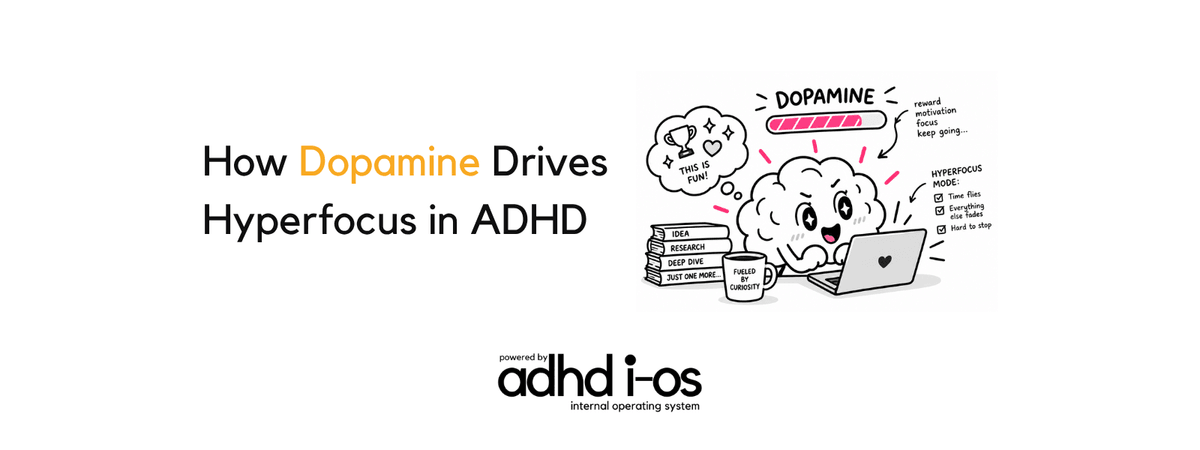
That's dopamine, or more specifically, a brain that hands out its attention based on how much a thing is currently generating rather than how much it's supposed to matter. The spreadsheet generates almost nothing. The video generates a small hit every few seconds, a new detail, a payoff, a reason to keep watching, and your brain follows whichever one is actually giving it something to work with.
Once you see the mechanism that way, both stories stop looking like a contradiction. They're the same system, just measured at two very different fuel levels. If you want the fuller picture of what hyperfocus looks like once that system fills up completely, What Is ADHD Hyperfocus? A Simple Explanation covers that ground. This piece is about the fuel itself, and why some tasks never seem to get any.
Work With It, Not Against It: Four Dopamine-Aware Tools
Interest is the fuel here, more than motivation, and you can manufacture some of it on purpose. None of these require more discipline, just a different angle on the same task:
- Attach a small, immediate reward to a boring task instead of relying on some future payoff, a coffee you actually like, five minutes of something fun the second it's done.
- Add novelty on purpose: change location, use a new pen, set a silly timer and race it.
- Turn a flat task into a race, a game, or a challenge against yourself, anything that gives the brain a reason to care right now.
- Notice what you hyperfocus on for free, then ask what part of that could be borrowed for the task you're avoiding. Competition, curiosity, a countdown, all of it transfers more than people expect.
So why does the brain respond to interest instead of importance in the first place? It comes down to what dopamine is actually doing.
What Dopamine Actually Does
Dopamine does more than make you feel good. It's central to motivation, reward anticipation, and helping the brain decide what's worth paying attention to in the first place. The National Institute on Drug Abuse describes dopamine as a core part of how the brain flags which experiences are worth pursuing again, which is part of why activities that feel novel or rewarding tend to pull focus more easily than ones that don't.
The National Institute of Mental Health frames ADHD around differences in attention regulation, executive functioning, and impulse control. Exactly how dopamine signaling differs in ADHD brains is still genuinely debated among researchers, the evidence is mixed and far from settled. But clinically, a widely used framework, sometimes called an interest-based nervous system, describes what a lot of ADHDers actually experience: attention that responds more reliably to curiosity, novelty, challenge, or urgency than to importance on its own.
ADHD brains generally aren't short on motivation so much as they're running on that interest-based system more than an importance-based one.
Why Boring Tasks Feel Nearly Impossible
A task with no built-in stimulation, novelty, or urgency often doesn't generate enough pull to hold attention, no matter how important it objectively is. The brain isn't being lazy in that moment, it's just not getting much of a signal to engage.
That's staring at the same form for twenty minutes without starting it, rereading the first field over and over. Doing the dishes only after inventing a reason it's suddenly interesting, like turning it into a race against a podcast episode. Needing an actual deadline, ideally one that's uncomfortably close, before any pull toward starting shows up at all. This is exactly the mechanism behind the ADHD boredom spiral: understimulation, not overwhelm, quietly derailing a task that should have been simple.
Why Interesting Tasks Take Over Completely
When a task does supply enough novelty, challenge, or reward, that engagement tends to hold steady instead of tapering off the way it does with something flat. The brain locks in and stops checking in on anything else, hunger, texts, the time, a conversation happening two feet away, which is a lot of what hyperfocus looks like from the inside.
Hyperfocus isn't so much a stronger version of normal focus as what happens once something finally gives the brain enough to work with. Why ADHD Brains Can Hyperfocus on Interesting Tasks digs further into why that lock-in can feel almost effortless once it starts, even on days when starting anything else felt impossible.
This Explains More Than Just Focus
The same interest-based pattern shows up across ADHD experiences that don't look related on the surface: chasing a new idea instead of finishing the current one, needing a deadline to actually move, getting hooked on a hobby overnight. None of these are separate quirks. They're different expressions of the same wiring, attention that follows what's engaging rather than what's scheduled.
Reframing "Just Focus"
Telling an ADHD brain to just focus on something boring is asking it to manufacture a response it doesn't naturally produce for that particular task. The more useful question isn't "why can't I focus," it's "what would make my brain want to."
Understanding the dopamine piece turns focus from a character issue into a design problem, and design problems have workarounds.
Your Focus Runs on a Different Fuel
ADHD hyperfocus and ADHD distraction come from the same underlying reward system, just pointed in different directions. A flat, low-stimulation task rarely earns enough attention on importance alone, while something genuinely interesting or novel tends to hold that attention steady, which is a lot of what creates hyperfocus in the first place.
Adding manufactured interest, novelty, or urgency can help bridge the gap in between.
Explore more neuroscience-backed ADHD insights at adhd i-os and learn how to work with your brain's reward system instead of fighting it.