

Why ADHD Brains Can Hyperfocus on Interesting Tasks
Why ADHD Brains Can Hyperfocus on Interesting Tasks
Most of us grow up believing that motivation follows importance.
The logic seems obvious. The more something matters, the easier it should be to do. Paying your bills should come before watching YouTube. Responding to an email should take priority over researching a hobby you discovered yesterday. If you know the consequences of putting something off, getting started shouldn't be the hard part.
For many people with ADHD, everyday life tells a different story.
You can spend the entire morning thinking about a task that needs to be done and still struggle to begin it. Then a completely unrelated topic catches your attention, and suddenly hours disappear. By the end of the day, you've learned everything there is to know about mechanical keyboards, medieval architecture, or sourdough starters, while the email that would have taken five minutes remains unanswered.
That contradiction sits at the heart of one of the biggest misunderstandings about ADHD.
If people with ADHD can focus that intensely, how can they also struggle to focus at all?
The answer isn't that ADHD is a lack of attention. Increasingly, researchers describe it as a difference in how attention is regulated. If you're looking for a broader explanation of what hyperfocus is and how it feels, we've already explored that in ADHD Hyperfocus Explained. This article asks a different question: why does the brain become completely absorbed by some tasks while resisting others that seem far more important?
Understanding that question changes the way hyperfocus makes sense.
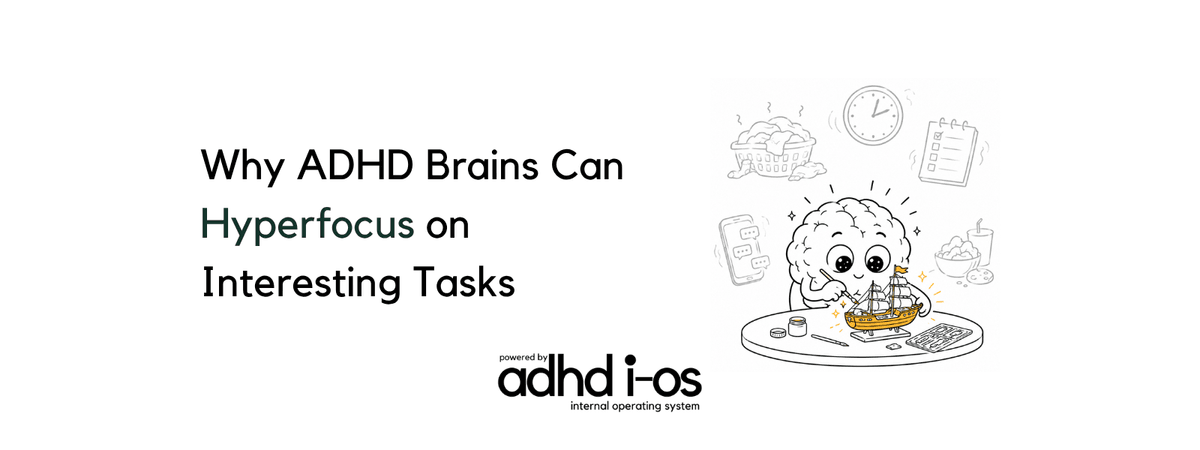
Importance Isn't Always What Gets Your Brain's Attention
Imagine two tasks sitting next to each other.
One is renewing your driver's license before the deadline. The other is learning how Saturn's rings formed.
Logically, the first task should win every time. It has consequences, a deadline, and a clear benefit. Yet many ADHDers know what it's like to spend an entire evening reading about planetary science while the license renewal quietly waits until tomorrow.
It's easy to mistake that for poor priorities.
More often, it's a reflection of how the ADHD brain decides what deserves its attention.
The National Institute of Mental Health describes ADHD as involving differences in attention regulation, executive functioning, and impulse control. Rather than asking whether someone can focus, researchers are increasingly interested in understanding what makes focus easier to start, harder to sustain, or unexpectedly difficult to shift.
That perspective helps explain why importance isn't always enough.
Knowing a task matters doesn't necessarily create the mental momentum needed to begin it. Some activities naturally generate that momentum because they're novel, challenging, personally meaningful, or simply interesting. Others ask the brain to invest effort before offering much in return.
The result can look confusing from the outside. Someone may avoid a routine task for days, then spend an entire afternoon solving a problem nobody asked them to solve. The amount of focus hasn't changed nearly as much as what the brain decided was worth focusing on.
Curiosity Has a Different Kind of Pull
Think back to the last time something genuinely captured your curiosity.
Maybe it was a documentary that answered one question and immediately created five more. Maybe a friend mentioned an unusual hobby, and before long you were reading forums, watching tutorials, and comparing equipment you never planned to buy. You probably didn't schedule time for that deep dive. It happened because one interesting idea naturally led to the next.
Some ADHD clinicians, including psychiatrist Dr. William Dodson, have described this pattern as an interest-based nervous system, a concept discussed through ADDitude Magazine. The phrase doesn't mean people with ADHD only do things they enjoy. It suggests that curiosity, novelty, challenge, urgency, and personal meaning often have a stronger influence on attention than importance by itself.
That's a subtle distinction, but it explains a surprising amount.
Interest creates its own momentum. Each answer generates another question. Every new discovery makes the next one feel worthwhile. Before long, staying engaged no longer feels like work because the activity itself keeps producing reasons to continue.
Routine tasks rarely work that way.
Filing paperwork, answering emails, or organizing receipts usually don't become more interesting after the first few minutes. They ask your brain to keep investing attention without giving much back, which is why they can feel disproportionately difficult even when they're objectively simple.
The same pattern also helps explain why many ADHDers are drawn toward exciting new ideas before finishing existing ones. We explored another side of that tendency in ADHD and the Shiny Object Syndrome, where novelty creates enough momentum to compete with projects that have already become familiar.
Why Hyperfocus Rarely Feels Like Hard Work
When people hear the word hyperfocus, they often imagine someone forcing themselves to concentrate with extraordinary discipline.
For most ADHDers, the experience feels almost effortless.
One moment you're casually looking something up. The next, you've lost track of time completely. Notifications go unnoticed. Hunger arrives hours later than expected. Someone says your name, and you barely register that they spoke.
The work itself hasn't become easier. What's changed is the amount of mental effort required to stay engaged.
One reason researchers believe this happens involves dopamine, a neurotransmitter that helps regulate motivation, reward, learning, and attention. According to the National Institute on Drug Abuse, dopamine plays an important role in helping the brain decide which experiences are worth pursuing. Activities that feel rewarding, meaningful, or novel tend to activate these systems more strongly, making sustained engagement feel much more natural.
Compare that with a repetitive administrative task.
Every few minutes your attention begins drifting because the activity isn't providing enough feedback to keep your brain invested. You repeatedly have to pull yourself back, which is why thirty minutes of paperwork can feel more exhausting than three hours spent building, creating, researching, or solving a problem you genuinely care about.
Hyperfocus isn't simply "good focus."
It's what happens when interest and attention become tightly aligned. Once that happens, the brain stops needing constant reminders to stay engaged because the activity itself is doing most of the work.
When Hyperfocus Solves One Problem and Creates Another
Being able to concentrate deeply sounds like an advantage, and sometimes it is.
Some of the most creative work people with ADHD produce happens during periods of hyperfocus. Artists lose themselves in a painting. Programmers build for hours without noticing the clock. Entrepreneurs suddenly solve a problem that's been sitting untouched for weeks. Students absorb an entire subject in a single afternoon because one interesting question led to another.
Those experiences are real strengths.
The difficulty is that hyperfocus doesn't arrive with a built-in sense of proportion.
While your brain is fully invested in one activity, everything else becomes quieter. Hunger fades into the background. Text messages go unanswered. Meetings are forgotten. You promise yourself you'll stop after "just one more thing," only to look up and realize the evening has disappeared.
Many people describe the experience as feeling less like choosing to stay focused and more like being reluctant to leave. Shifting your attention away from something engaging can feel surprisingly uncomfortable, even when you know another task is more important.
That's because hyperfocus isn't designed to help you prioritize your day. It's simply the brain remaining deeply engaged with whatever currently provides enough stimulation to hold its interest.
The University of Michigan ADHD Program and McGovern Medical School both note that ADHD often affects the ability to regulate attention and transition between activities. Staying engaged isn't necessarily the difficult part. Sometimes the harder task is knowing when to stop.
"If You Can Focus on That, Why Can't You Answer an Email?"
Few questions frustrate people with ADHD more than this one.
On the surface, it sounds reasonable. If someone can spend six hours restoring an old motorcycle or learning everything there is to know about astrophotography, surely they can spend ten minutes replying to an email.
The comparison assumes that attention works like a switch. Turn it on, point it at the task, and the job gets done.
For many ADHDers, it feels more like trying to steer a current.
Some activities naturally pull attention toward them. Others require constant effort to stay with because the brain keeps looking for something more stimulating. That doesn't mean the email is unimportant or the person doesn't care about the outcome. It means the task isn't generating enough momentum to compete with everything else asking for attention.
This misunderstanding often creates unnecessary shame.
From the outside, hyperfocus can look like proof that someone is capable of focusing whenever they choose. From the inside, it often feels like evidence that your brain follows its own rules.
That's why hyperfocus doesn't contradict ADHD.
In many ways, it illustrates it.
The same attention system that struggles to engage with low-stimulation tasks can become remarkably stable once something captures enough interest. Those experiences are two sides of the same mechanism rather than separate problems.
Asking a Better Question
For years, many people with ADHD have asked themselves the same question: "Why can't I focus?"
It's understandable, but it may not be the most useful question.
A better one might be: "What helps my brain stay engaged?"
That shift doesn't remove deadlines or make repetitive tasks suddenly enjoyable. What it does offer is a more accurate understanding of how your attention works.
Some tasks naturally create enough interest to sustain themselves. Others benefit from strategies that add novelty, urgency, accountability, or immediate feedback. Those approaches aren't shortcuts or signs of weakness. They're ways of working with the attention system you have instead of expecting it to behave like someone else's.
The same idea connects to several other ADHD experiences. Difficulty getting started, losing track of time, chasing new ideas, or forgetting routine tasks aren't isolated quirks. They often reflect different expressions of the same attention-regulation system. We explore those connections in ADHD Brain Waves Explained and ADHD Working Memory Deficits: Why Instructions Don't Stick, where the conversation shifts from what ADHD looks like to why it behaves the way it does.
Understanding that bigger picture doesn't eliminate hyperfocus.
It does make it easier to stop interpreting it as a contradiction.
Why ADHD Focus Follows Interest
Hyperfocus has always seemed confusing because most of us were taught that attention follows importance.
ADHD suggests something more nuanced.
Importance matters, but it isn't always what captures the brain first. Curiosity, novelty, challenge, and personal meaning often have a stronger influence on where attention settles and how long it stays there. When those ingredients are present, focus can become remarkably steady. When they're missing, even simple tasks may feel surprisingly difficult to begin.
That doesn't mean people with ADHD lack discipline, nor does it mean hyperfocus is a hidden superpower. Like many ADHD traits, it has strengths and costs that often arrive together.
The more useful takeaway is that attention isn't behaving randomly. It's responding to a set of signals that don't always match the way the rest of the world expects motivation to work.
Recognizing those patterns replaces a lot of unnecessary self-criticism with something far more practical: understanding.
If you're interested in exploring the neuroscience behind everyday ADHD experiences, visit adhd i-os. Each article is designed to connect current research with the moments that make people stop and think, "That explains so much."