

ADHD and Motivation Cycles: Why You Feel "All In" or Nothing
ADHD and Motivation Cycles: Why You Feel "All In" or Nothing
Yesterday you couldn't stop thinking about it. You had the tab open all night, sketching out how it would go, half-writing the plan in your head before you even sat down. Today you open your laptop and stare at the same project like it's a stranger's, and you can't explain what shifted between then and now.
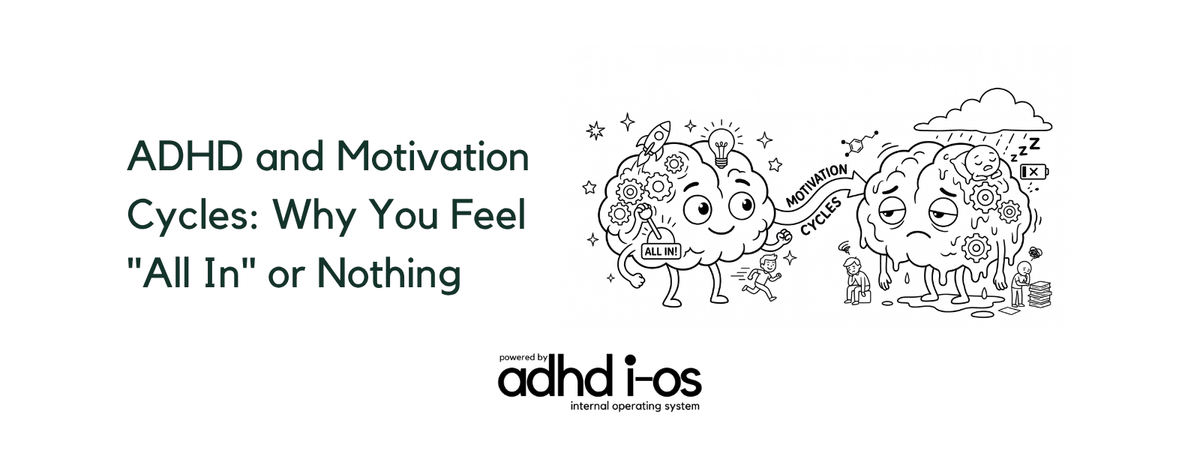
Why Do You Wake Up and Suddenly... Not Care Anymore?
You made a supply list, mapped out the whole plan in your head, pictured exactly how it would look finished, maybe even told three people about it because you couldn't hold the excitement in. Now the cursor just sits there blinking. What changed?
Many ADHDers experience motivation this way, like something that switches on and off without warning, no dimmer, no gradual fade, just on and then suddenly not. It's confusing, because the desire was real. The excitement was real. Then it was just gone, and no amount of reminding yourself how much you cared yesterday brings it back today. So what actually makes ADHD motivation feel this inconsistent?
Motivation Isn't Just Willpower
Motivation depends on several brain systems working together: reward, anticipation, attention, and how emotionally significant something feels in the moment. None of those run on willpower alone, and for ADHD brains specifically, that mix leans more on interest than on importance.
CHADD's overview of executive function references two of the field's leading researchers, Russell Barkley and Thomas Brown, who both place self-regulation of motivation inside the executive function system rather than treating it as a separate willpower issue. Barkley specifically identifies motivation and arousal as one of the core areas ADHD can disrupt, right alongside working memory and self-control. Brown's model groups it with focusing, sustaining, and shifting attention, treating all of it as one interconnected system rather than isolated skills you either have or don't.
The Cleveland Clinic describes this kind of struggle to start a task, especially one that seems difficult or uninteresting, as a hallmark of executive dysfunction, and notes that trying to force it can feel like a record stuck skipping on the same part of a song. You want to fix it. You can see exactly what needs to happen next. It still won't budge on command. That's not laziness, and it's not a lack of caring. Your brain's engagement changed, not your character.
The "All In" Phase
When motivation is high, ideas flow fast, energy feels endless, and time disappears entirely. A five-minute check-in turns into a two-hour deep dive and you don't notice until your neck is stiff. Everything about the project feels possible, obstacles feel like fun puzzles instead of roadblocks, and a lot of ADHDers mistake this state for their baseline instead of recognizing it as one phase of a cycle.
Psychiatrist William Dodson, writing for ADDitude, calls this an interest-based nervous system. Where most people can act on a task simply because it's important, or because someone they respect expects it done, ADHD brains generally need the task itself to be interesting, urgent, novel, or challenging before real engagement kicks in. Once one of those is present, the brain can enter what Dodson calls "the zone," where executive function difficulties, the same ones that made starting anything feel impossible last week, often disappear entirely for as long as the state lasts.
That's the buying-supplies-for-a-new-hobby energy, the mapping-out-a-huge-project-at-midnight energy, and the reason six hours can vanish before you notice you never ate lunch. It's real focus, not performance for anyone watching, and it can feel like proof that nothing was ever actually wrong with your attention in the first place.
The "Nothing" Phase
Then the same task suddenly feels boring, or heavy, or so overwhelming you can't even locate a starting point, even though you loved it yesterday. Opening the file feels like wading through mud. The idea that felt urgent twelve hours ago now barely registers. The project didn't change. Your brain state did, and that gap between how something felt and how it feels now is exactly what makes this phase so disorienting.
This shift is part of why procrastination shows up so often alongside ADHD. Dodson notes that people with an interest-based nervous system want to get things done and understand what's important, but importance alone rarely moves the needle the way it does for a neurotypical brain, which relies more heavily on that concept to get started in the first place. Once the novelty, urgency, or challenge fades, so does the access, and no amount of telling yourself it matters brings the engagement back on its own.
Why Motivation Feels Like a Roller Coaster
Motivation tends to rise with novelty, curiosity, urgency, and challenge, and fall the moment those same things disappear. That's why the first week of a new hobby feels effortless and the third week feels like pulling teeth: the novelty that was doing most of the work has quietly worn off. Deadlines create a version of urgency the ADHD brain can genuinely use, which is part of why so many ADHDers do their best work under real time pressure, whether they'd choose that pattern for themselves or not.
A closer picture than a switch flipping on and off is a surfer waiting on the water. Some days there's a wave to catch, something interesting or urgent enough to ride all the way in. Some days it's still water, and no amount of paddling harder or wanting it more conjures a wave that isn't there. The surfer isn't failing on the still days. The conditions are just different, and reading the water matters more than fighting it.
Why This Doesn't Mean You're Lazy
A lot of ADHDers blame themselves for how inconsistent their motivation looks from the outside, especially when someone else notices the gap. "You spent four hours on that yesterday, why can't you do ten minutes today?" is a hard question to answer honestly in the moment, because the honest answer, "the conditions that made yesterday possible aren't here anymore," doesn't sound like a real excuse from the outside.
But inconsistency isn't the same as indifference. Caring deeply about a project, genuinely wanting to start it, and still feeling completely stuck can all be true at the same time, and that combination is exactly what confuses people who've never experienced it themselves. The Cleveland Clinic is direct about this distinction: procrastination is a conscious choice to delay something, while executive dysfunction happens because the parts of the brain that handle self-motivation and planning aren't working the way they would in someone without the condition. That's not something you can just decide your way out of, no matter how much the task matters to you on paper.
Your motivation is real, just harder to regulate, the same underlying pattern behind ADHD mental noise and distraction versus hyperfocus: a brain that responds strongly to some signals and barely at all to others.
Reframing Motivation
ADHD isn't about having no motivation. It's about having motivation that shifts with brain state, stimulation, and engagement, the same dopamine-driven reward system that governs what any brain treats as worth pursuing, just tuned to respond to a narrower, more specific set of triggers.
The more useful question was never "why am I so inconsistent." It's "what is my brain responding to today," because that's the question with an actual answer.
The Shift Has a Cause
ADHD motivation is often state-dependent rather than fixed. Dopamine and interest shape engagement more than importance does. That fluctuation is normal for a lot of ADHD brains, not a sign that something is wrong with you, and understanding the cycle is what actually starts to reduce the shame that builds up around it.
Explore more neuroscience-backed ADHD insights at adhd i-os and learn why motivation isn't simply about trying harder.