

ADHD Mental Noise: Why Your Thoughts Won't Quiet Down
ADHD Mental Noise: Why Your Thoughts Won't Quiet Down
You're exhausted. You finally crawl into bed. And somehow your brain decides now is the perfect time to replay a conversation from 2017 you never even thought about again until this exact second.
Then it's next week's grocery list. Then a half-written text you forgot to send. Then that song. You know the one.
Most ADHDers have plenty of thoughts. What's missing is the quiet in between them. So why does the ADHD brain keep generating thoughts even in moments when nothing is actually happening around it?
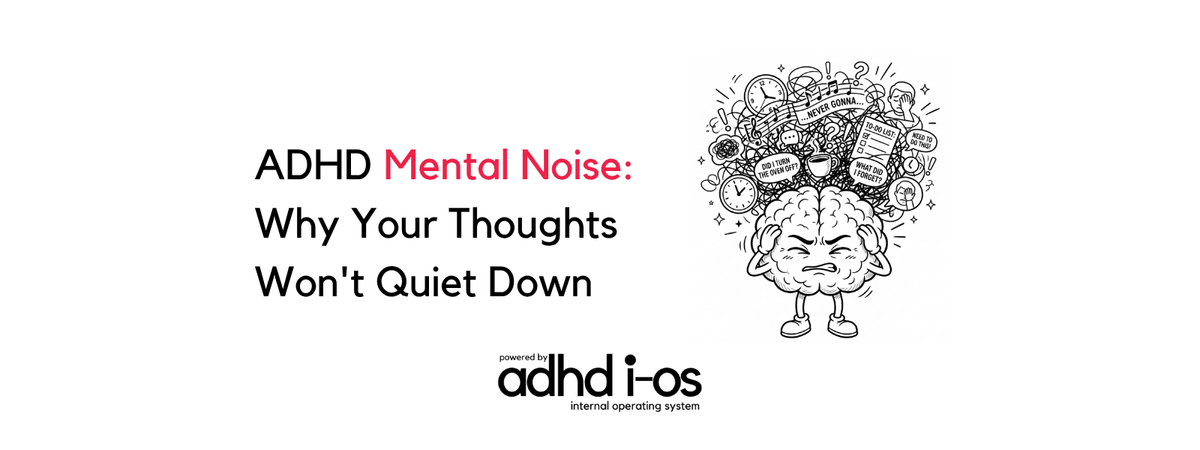
Mental Noise Isn't Just "Thinking Too Much"
Mental noise isn't one thing. It's usually several things happening at once: an unfinished thought from an hour ago, a conversation you're having with yourself, a random memory, a plan for tomorrow, a song stuck on loop, and an idea that showed up uninvited and refuses to leave.
Thoughts crowd in fast. Filtering them is the harder part. The National Institute of Mental Health describes ADHD as a pattern rooted in attention regulation rather than a shortage of attention, and that lines up with what's happening here: the ADHD brain tends to keep more information active at once instead of quietly archiving what isn't currently useful.
Once you see it that way, the exhaustion starts to make sense. Your brain keeps more tabs open than most, and every single one is convinced it deserves your attention right now.
The Brain's "Filter" Doesn't Always Filter
Picture your brain like a group chat. Most brains mute the conversations that don't matter in the moment. Someone posts something irrelevant, it stays there, unread, quietly waiting. The ADHD brain has a harder time doing that. Every chat keeps sending notifications, whether or not the message actually matters right now.
That shows up in ordinary moments more than dramatic ones. You remember five unrelated things while brushing your teeth. You're thinking about tomorrow while typing today's email. A random lyric interrupts a meeting you're supposed to be paying attention to. None of it comes from a lapse in effort. Competing internal signals are demanding equal airtime, and none of them are willing to wait their turn.
Why Quiet Moments Can Feel the Loudest
Here's the part that trips people up: mental noise often gets worse, not better, in the quietest moments. It shows up trying to fall asleep, standing in the shower, driving somewhere familiar, or sitting still with nothing else to do.
Reduced external stimulation doesn't switch off internal activity, it just removes whatever was masking it. General research on stress and the brain, like the overview from Johns Hopkins Medicine, backs up the basic idea that your body's internal state keeps running even when the outside world goes quiet. Silence doesn't always make the ADHD brain quieter. Sometimes it makes it easier to hear everything already happening inside.
That's why bedtime can feel like the loudest part of the day. Nothing is demanding your attention anymore, so your brain finally has the floor, and it has a lot to say.
The Focus Tax of Mental Noise
Focus gets talked about like it's just paying attention. It's actually the opposite skill too: ignoring everything else. The National Institute of Neurological Disorders and Stroke, among its broader work on the brain's attention and cognitive control networks, points to a simple idea that applies here: every unrelated thought, memory, or idea competing for space makes focus harder, whether you're in a conversation, reading a page, working through a task, or trying to make a simple decision.
The result is a brain working overtime just to stay on one thing. Focusing while managing mental noise means doing two jobs at once, and only one of them is visible to anyone else in the room.
Why It Isn't "Overthinking"
"You're just overthinking it" is one of the most common things ADHDers hear, and one of the least accurate. Overthinking implies a choice, and mental noise rarely feels like one.
You didn't decide to replay that conversation. You didn't choose the random worry that showed up out of nowhere. You didn't ask for an unrelated idea to interrupt whatever you were doing. Psychologists generally draw a line between deliberate rumination and involuntary intrusive thoughts (the American Psychological Association is a good starting point for more on that distinction), and ADHD mental noise tends to lean toward the involuntary side. Constantly narrating your own life in your head is what a brain does when it struggles to file information away instead of keeping it active.
That distinction matters, because "just stop overthinking" assumes a switch that isn't there.
Reframing the Busy Mind
Calling this laziness, or a discipline problem, or proof you haven't tried enough mindfulness apps skips the actual mechanism. A brain processing a lot of competing signals at once hasn't been taught, or built, to quiet the ones that don't matter yet.
The goal was never to stop thinking altogether. Nobody's brain works that way, ADHD or not. The more useful goal is understanding why yours keeps so many thoughts active at the same time, so the noise stops feeling like a personal failing and starts feeling like information.
A Full Brain, Not a Broken One
Mental noise is different from ordinary overthinking. ADHD brains often struggle to filter competing thoughts rather than simply generating more of them. Quiet environments can make that internal activity feel louder, not calmer. Understanding all of this does something more valuable than any productivity hack: it takes the self-blame out of the equation.
None of it makes you lazy or undisciplined. It just means your brain holds onto more at once than most, and once you know that, the noise stops feeling like proof something is wrong with you.
Explore more neuroscience-backed ADHD insights at adhd i-os and find out why your brain sometimes feels louder than the world around it.