

Hyperfocus vs Distraction in ADHD: Why They're Not Opposites
Hyperfocus vs Distraction in ADHD: Why They're Not Opposites
Monday, you can't hold a thought for five minutes. Tuesday, you look up and three hours are gone, and you don't remember standing up once.
Both of those are still you. Both of those are still ADHD. So how does the same brain lose focus that fast and then refuse to let go of it at all?
This is one of the most misunderstood parts of ADHD. People assume the problem is a shortage of attention, like a tank that runs low. CHADD and the Cleveland Clinic both describe ADHD less as a shortage and more as a regulation issue, the system that decides where attention goes, how long it stays, and when it lets go.
Attention Has Four Jobs
Attention isn't one skill. It's four: starting a task, sustaining it, shifting away from it, and stopping it once it's done. ADHD can interrupt any one of those, and rarely the same way twice.
Sometimes the brain struggles to engage at all, and a five-minute task turns into twenty minutes of circling it. Sometimes it engages too deeply and loses track of everything else. Sometimes it engages fine but can't let go once the task is actually finished, a pattern that overlaps closely with ADHD working memory challenges, since sustaining attention and holding information active draw on a lot of the same resources.
The National Institute of Mental Health frames ADHD around differences in attention regulation rather than a flat deficit, and a review of executive attention research points to that same four-part breakdown, starting, sustaining, shifting, stopping, as the places where things tend to go differently.
Picture a spotlight instead of a dimmer. A spotlight can be aimed anywhere, but once it locks onto something, moving it takes real effort. That's a closer picture of ADHD attention than any story about having too much or too little of it.
Why Distraction Happens
Most people picture distraction as an outside interruption, a notification, a noise, someone talking nearby. For a lot of ADHD brains, distraction starts from the inside instead. A new idea shows up mid-task. A half-finished thought resurfaces. Curiosity about something completely unrelated wins out over whatever's actually in front of you, the same internal tug-of-war behind ADHD mental noise.
Research on attention networks points to a brain that shifts toward whatever offers more stimulation in the moment, external or entirely self-generated.
It shows up in small ways. You stop mid-task to Google one question. You check a single notification and resurface twenty minutes later. You remember something unrelated halfway through a sentence you were saying out loud. None of that comes from a lack of trying. It's the attention system following whatever pulls hardest right now.
Why Hyperfocus Happens
Hyperfocus runs on that same system, aimed a different direction. When a task offers enough interest, challenge, novelty, or reward, the brain can stop shifting attention altogether. (For a closer look at how that plays out day to day, see ADHD Hyperfocus Explained.)
ADDitude Magazine's coverage of hyperfocus, drawing on ADHD researchers and clinicians including psychologist Kathleen Nadeau, describes attention locking onto one target instead of naturally moving between tasks the way it does for most people. The National Institute on Drug Abuse has documented dopamine's role in what a brain treats as worth sustained attention, and ADHD brains often need a bigger hit of interest before a task earns that lock.
That locked-in state stays locked instead of actually improving. It's a system that stopped shifting, not one performing better.
Same System, Different Outcome
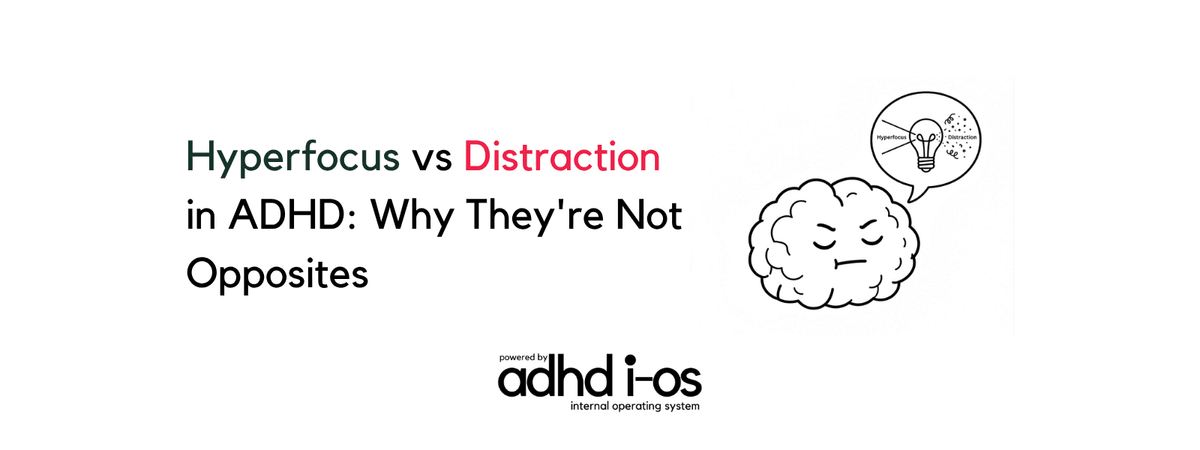
Distraction and hyperfocus look like opposite problems. They come from the same regulation system, just running in different directions.
Think of a dimmer switch that's supposed to hold somewhere in the middle but instead swings between barely on and fully cranked. Morning, you can't stay on one task for five minutes. That night, you can't put the same kind of task down. Same brain. Different state, depending on what it's responding to in that moment.
Regulation, not quantity, is the mechanism at play, which is part of why the same person can look like they have zero focus one hour and unstoppable focus the next.
Why This Creates So Much Confusion
"You focused on that yesterday, so why can't you focus now?" is one of the most common things ADHDers hear, and one of the hardest to answer honestly in the moment.
ADHD attention responds to interest, stimulation, fatigue, stress, and environment, and all five shift by the hour. Yesterday's task might have had a deadline attached, or someone watching, or simply better sleep behind it. Today it doesn't. Consistency is what's actually being asked for, and it's the one thing this system doesn't reliably deliver on command.
Reframing ADHD Attention
ADHD isn't about having too much focus or too little. It's about inconsistent access to focus.
The more useful question was never "can you focus." It's what the attention system is currently responding to, and whether that thing has enough pull to hold it.
There's a Reason the ADHD Brain Looks Inconsistent
Distraction and hyperfocus share the same neurological roots. ADHD is, at its core, a regulation challenge, and attention shifts based on stimulation, interest, and context rather than staying fixed by will alone. None of that makes the inconsistency a character flaw. It makes it a pattern, and a pattern can be worked with in a way random failure never can.
That's also why structure built around how this brain actually works tends to land better than a plan that just demands more willpower. Something like the Sprint Adventure Kit is built around exactly that: five minutes a day, brain-based connection points, and built-in accountability, instead of asking an inconsistent attention system to grind through a big plan by sheer will.
Explore more neuroscience-backed ADHD insights at adhd i-os and learn why ADHD attention responds to different things at different times, rather than simply being broken.