

ADHD and Multi-Step Tasks: Why Simple Instructions Feel Overwhelming
ADHD and Multi-Step Tasks: Why Simple Instructions Feel Overwhelming
Grab the folder. Print it. Bring it to the meeting. Three steps. You had the folder in your hand two minutes ago.
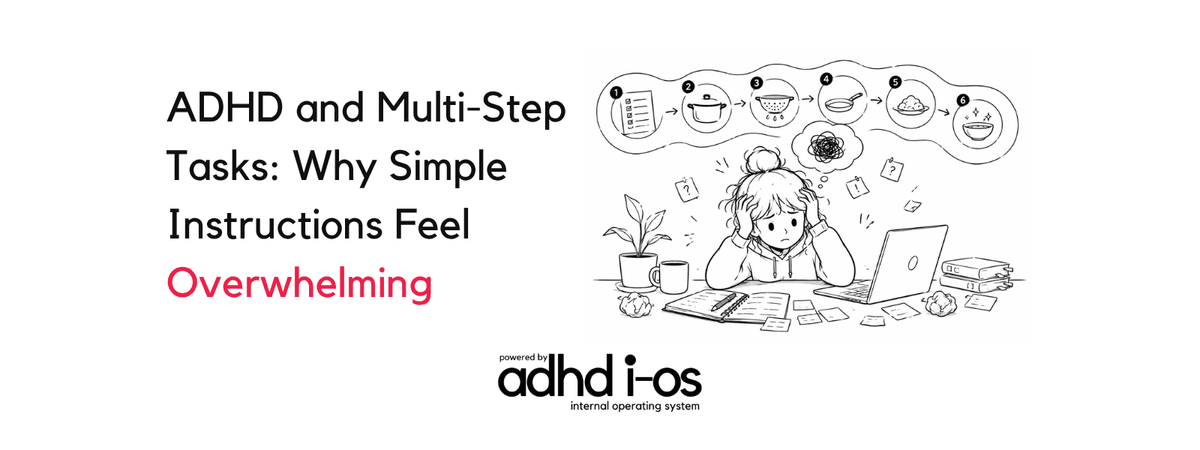
"It's Only Three Steps" Isn't Reassuring
Now you're standing in the kitchen with no folder and no idea why you walked in there.
People assume a simple instruction is an easy instruction. For an ADHD brain, "simple" and "easy" aren't the same thing. The number of steps matters less than whether all of them can stay loaded at once, and research on working memory and organizational skills in ADHD found large-magnitude working memory deficits that directly predict exactly this kind of breakdown.
Tools That Actually Help: Shrinking the Steps
Less to remember beats a better memory every time. Here's what that looks like in practice:
- Write the steps down externally, even for a 3-step task. Don't rely on holding them in your head.
- Do one step, then physically check it off before reading the next one.
- Say the next single step out loud right before doing it.
- Break "one task" into separate, visible mini-tasks rather than one instruction with hidden sub-steps.
So why does a timer or a checklist work better than trying harder? It comes down to what working memory is actually holding.
What Working Memory Is Actually Doing
Working memory works more like active, moment-to-moment juggling than storage: holding a step in mind while doing something else, then updating it for the next step. ADHD is linked to measurable deficits in exactly this system.
It's less like a full inbox and more like a countertop that's too small. New information doesn't wait patiently to be filed away somewhere. It knocks something else off.
Why Each New Step Can Erase the Last One
Multi-step tasks require constant task switching: finish this, shift attention, reload the next instruction. Research on adults with ADHD found they were measurably slower during task switches that also required shifting attentional focus, though speed held steady when attention didn't have to reconfigure. The slowdown shows up specifically at the handoff, exactly the moment a multi-step instruction demands.
That shows up as starting step two and forgetting whether step one actually got finished. Re-reading the same instruction line three times. Getting all the steps done, just wildly out of order.
It's Not About Intelligence or Effort
Multi-step confusion gets misread as not listening or not trying. It's neither. The steps were heard. They just didn't stay loaded long enough to execute in order.
Struggling with instructions and understanding instructions aren't the same thing. ADHD brains often do both: fully understand the task, and still lose the thread executing it, the same gap covered in ADHD Working Memory Deficits: Why Instructions Don't Stick.
You know what to do, and that was never the part breaking down.
Why the First Step Is Often the Hardest One
Multi-step tasks add a second barrier before working memory even gets involved: starting at all. A task that requires sequencing can feel heavier before a single step happens, because the brain is previewing the whole chain at once.
That's rereading the instructions five times before starting step one. Feeling exhausted by a task that hasn't technically started yet. This overlaps closely with why starting feels harder than doing in general, and it's a big part of why ADHD mornings in particular can feel so front-loaded with friction: getting dressed, packing a bag, and getting out the door is really one long multi-step task stacked on top of a brain that's still warming up.
Reframing "I Can't Follow Directions"
The instruction usually wasn't too complicated so much as it asked working memory to hold more than it reliably can, silently, with no visible sign of struggling until a step got dropped.
Externalizing steps isn't a crutch. It's handing the job to something that doesn't forget: paper, a checklist, a voice memo, anything outside the brain's own short-term holding space.
Your Brain Ran Out of Room to Hold the Instructions
Multi-step tasks tax working memory, a documented area of difference in ADHD. Task switching between steps is measurably harder, not a focus or effort issue, and struggling to execute steps is different from not understanding them in the first place.
Externalizing steps, writing them down, checking them off, reduces the load instead of demanding more willpower.
Explore more neuroscience-backed ADHD tools at adhd i-os and learn why carrying less in your head beats trying harder every time.