

Why Therapy Is Recommended So Often for Individuals with ADHD
Why Therapy Is Recommended So Often for Individuals with ADHD
Why Therapy Is Recommended So Often for Individuals with ADHD
At some point, every ADHDer hears it. You should try therapy. It’s easy to feel annoyed or assume it’s just the default advice people give when they don’t know what else to say.
But therapy isn’t recommended so often for ADHD because it’s trendy or because “everyone should go.” It’s recommended because ADHD affects far more than focus, and therapy is one of the few places where you can actually see how your brain works under the hood.
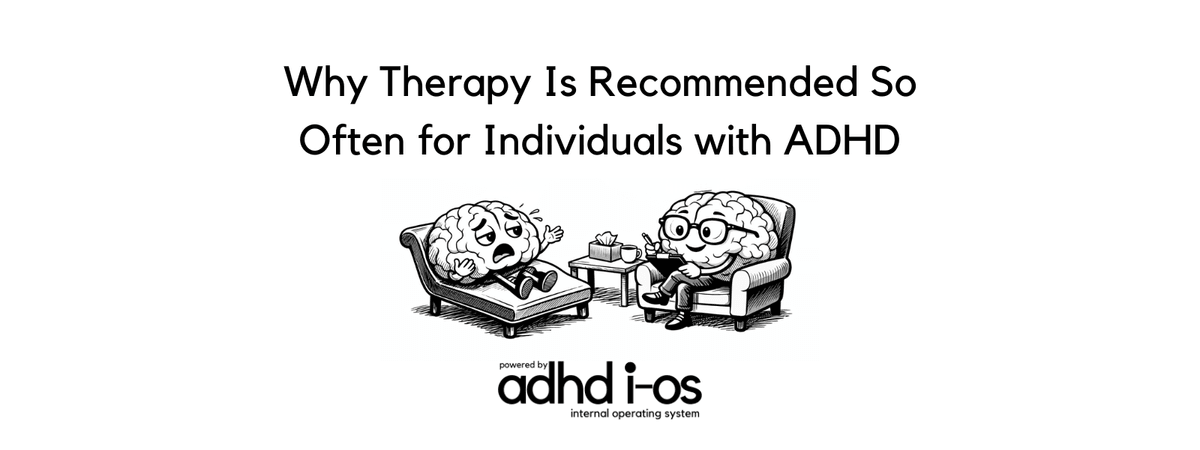
An Operating System, Not a Personality Flaw
Being neurodivergent doesn’t just change how well you pay attention. It affects executive function, emotional regulation, motivation, and self-awareness.
ADHD involves differences in areas like the prefrontal cortex (planning, inhibition, prioritization) and dopamine pathways that drive interest-based motivation rather than importance-based motivation. That’s why you can care about something and still struggle to act on it.
Major health organizations emphasize that ADHD is a neurodevelopmental condition, not a character issue or a discipline problem.
Therapy gives you a place to map how your operating system behaves under stress, boredom, rejection, and pressure without assuming anything is wrong with you.
What Therapy Does for ADHD Brains
Therapy for ADHD isn’t just “talk about your feelings.” In practice, it tends to do three very specific jobs.
First is self-awareness. Therapy slows life down enough to notice patterns like trigger → feeling → story → reaction. Once you can see the loop, you stop treating it as a moral failure and start treating it as data.
The second thing it does is emotional regulation. Many ADHDers never learned how to pause and repair; they learned to explode or shut down. Therapy provides co-regulation with a steady nervous system and teaches skills for coming back to baseline instead of staying stuck in emotional aftermath.
Finally, it helps with executive scaffolding. “Be more organized” turns into realistic routines, boundaries, scripts, and supports that actually fit how your brain works.
Over time, repeated noticing and different responses build new default pathways.
What Types of Therapy Typically Help ADHDers
Different therapy styles target different parts of the ADHD experience, from thought patterns to emotional regulation to day-to-day functioning.
Cognitive Behavioral Therapy
CBT helps you notice and challenge automatic thoughts like “I ruined everything” or “this proves I’m a failure.” It’s especially useful for shame spirals, catastrophizing, and the harsh self-talk many ADHDers internalize over time.
Dialectical Behavior Therapy
DBT focuses on emotion regulation, distress tolerance, and interpersonal skills. It’s often helpful for ADHDers who experience intense emotional reactions, conflict blowups, or difficulty calming their nervous system once it’s activated.
Acceptance and Commitment Therapy
ACT teaches you to make space for loud thoughts and feelings without letting them run the show. Instead of waiting to feel “better,” it helps you act in line with your values even when motivation or emotions are messy.
ADHD-informed or skills-focused therapy
This approach centers psychoeducation about how ADHD brains work, plus practical systems for routines, planning, and self-advocacy. It’s especially useful for turning abstract advice into concrete supports that fit real life.
But what matters more than the label is whether the therapist understands ADHD and neurodivergence. The American Psychological Association notes that therapy, often alongside medication, is a core part of adult ADHD treatment because it addresses emotional and behavioral regulation, not just attention.
Why Therapy Comes Up So Often
Therapy is recommended so frequently because ADHD affects more than attention. It shapes emotional responses, behavior patterns, and the internal narratives people use to make sense of themselves. Over time, these layers interact in ways that are difficult to untangle without outside perspective.
Medication can strengthen focus and motivation by improving signal strength in the brain. Meanwhile, therapy helps you use that signal by turning recurring behaviors into information.
If decision overwhelm or stress keeps hijacking your days, this connects closely with patterns explored in Decision Making with ADHD: Beyond Impulsivity & Overthinking and Cortisol and ADHD: How Stress Impacts Performance.
Is Therapy a Useful Next Step?
Consider a few questions:
- Do you notice recurring patterns you don’t fully understand?
- Does emotional fallout consume more energy than the task itself?
- Do you feel stuck between extremes, without a stable middle ground?
If these feel familiar, therapy isn’t a judgment on your coping. It’s a structured way to understand and adjust how your brain operates.
Turning Insight Into Support
If this post felt uncomfortably accurate, you’re not alone. Join the adhd i-os community for memes, vibes, and gentle “why is my brain like this” humor.
And if you want long-form, science-backed essays like this, follow the NeuroSpicy Weekly, where we discuss ADHD without shame, bootstraps, or pretending your brain is the problem.
Therapy isn’t about fixing you.
It’s about finally understanding the system you’re already running.